
Florida PE Continuing Education Courses & Bundles
Looking for Florida PE PDH courses? Explore online continuing education (CE) courses and bundles for your Florida PE license renewal.
Fulfill your requirements with an FBPE-Approved Provider (#0010824) | Online, Self-Paced Courses | LicensePoint Education
-
Florida PEs must complete 18 PDHs every 2 years:
1 Hour: FL Laws & Rules (Ch. 471 & FBPE Rules)
1 Hour: Professional Ethics
4 Hours: Area of Practice
12 Hours: Relevant Technical Electives
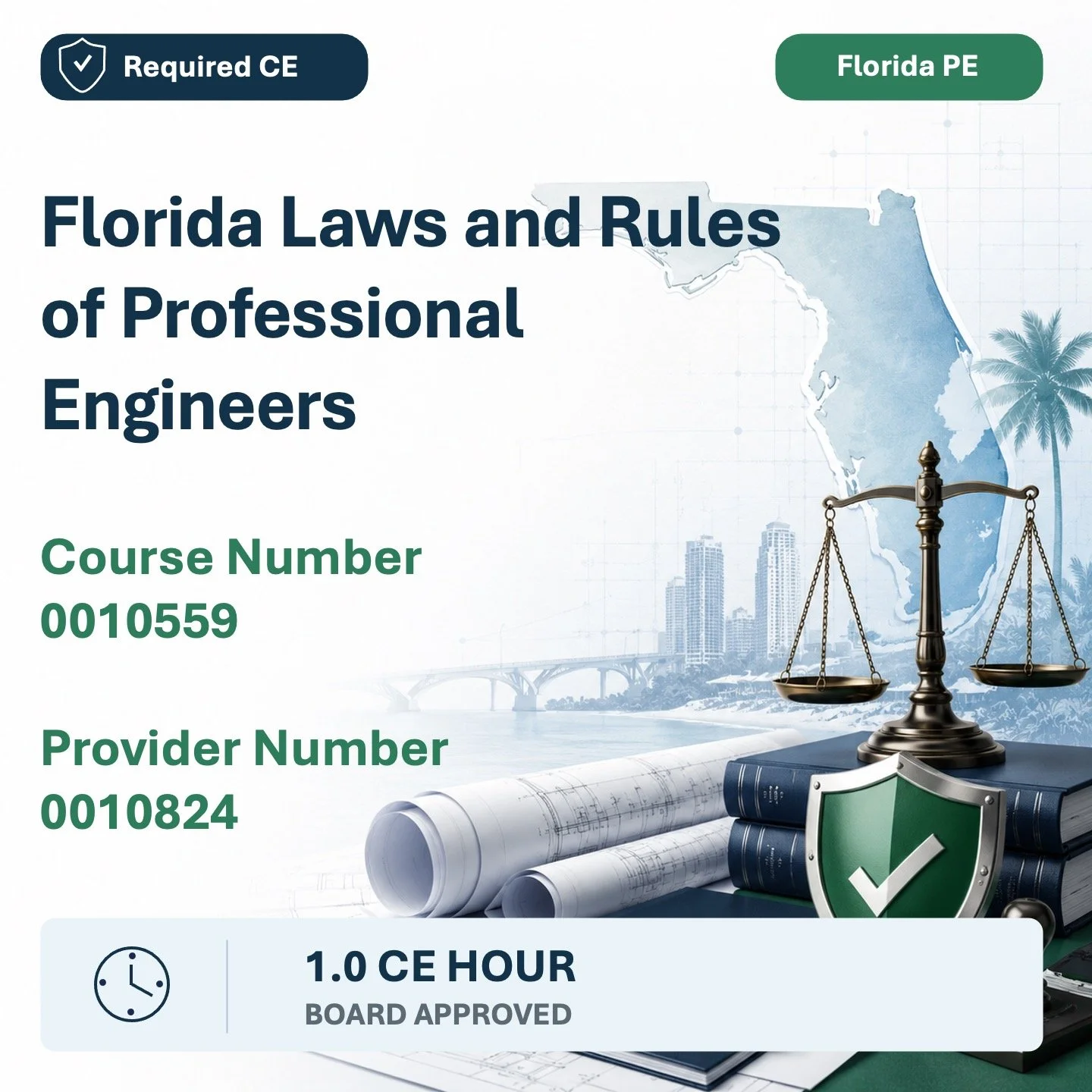
Florida PE Laws & Rules Course - 1 Hour
Complete the required FBPE Florida Laws & Rules continuing education course for professional engineers.
FBPE-approved provider #0010824 · Florida Laws & Rules: Board-approved course #0010559, 1 CE hour · DBPR Reporting · Instant Certificate
1 Hour
2 Hours
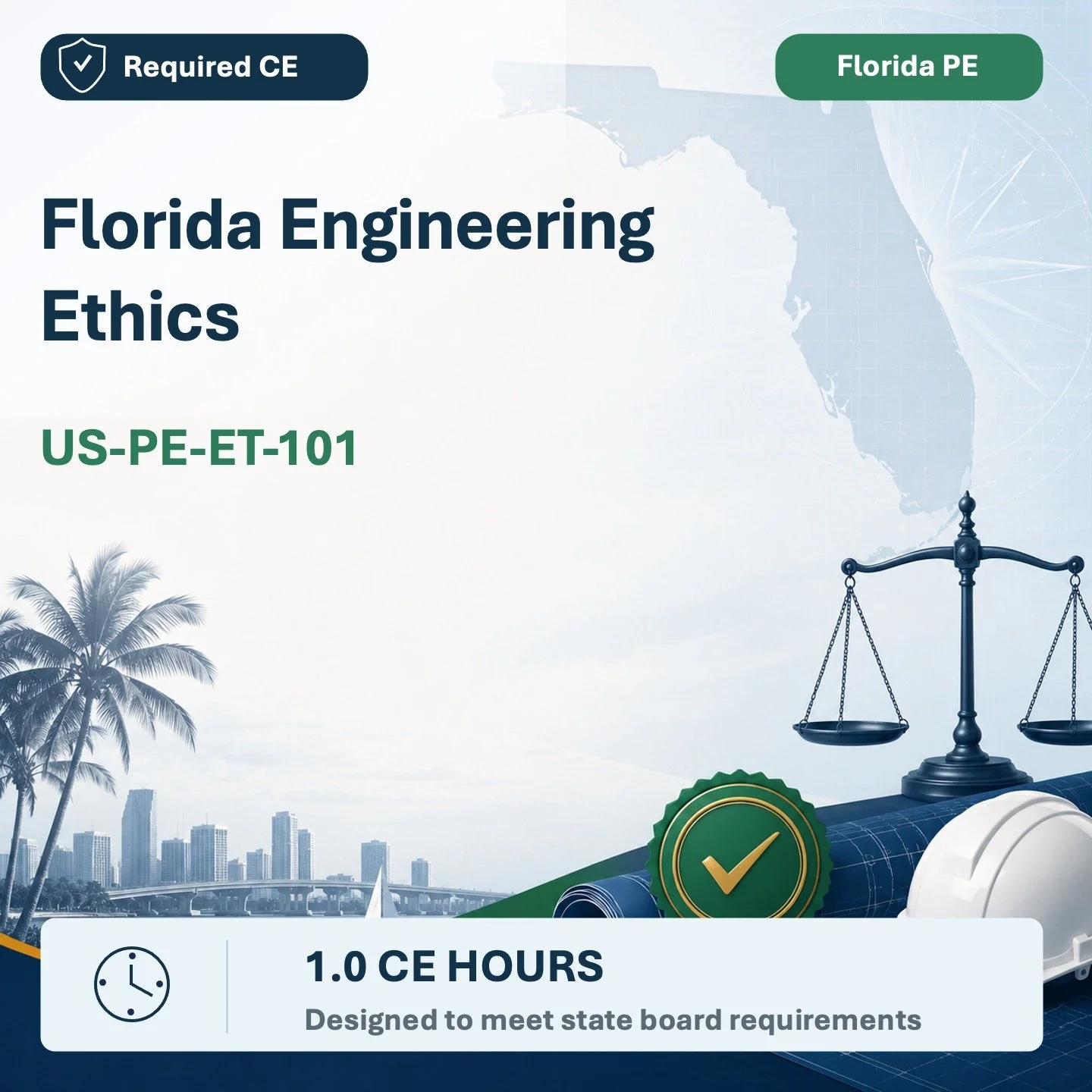
Florida PE Ethics Course - 1 Hour
Complete Florida’s required 1-hour professional engineering ethics continuing education course online. Instant access and completion certificate.
1 Hour
2 Hours

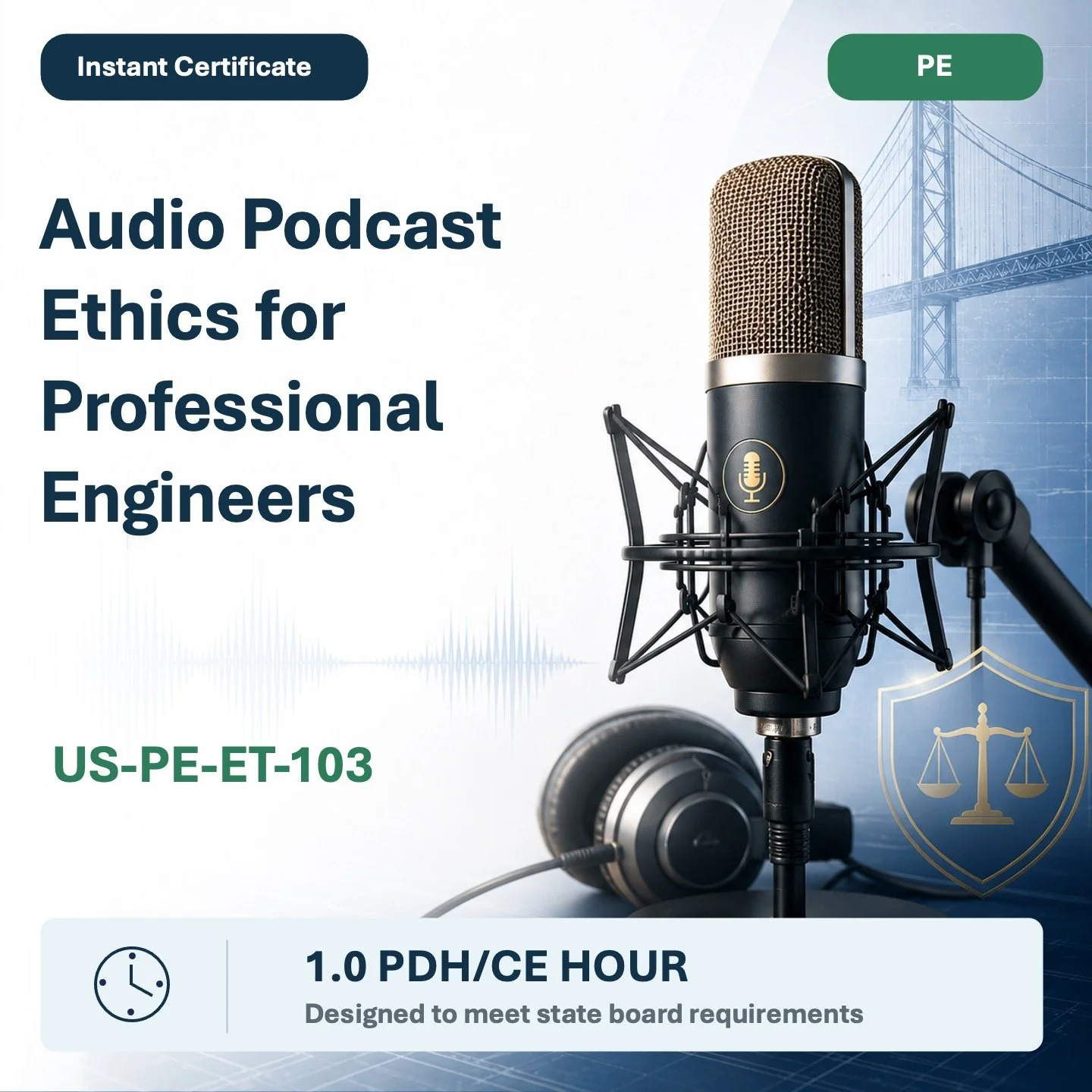
Florida PE Ethics Course in Audio Format
Complete your Florida PE ethics course in our audio-first format. Eligible for Florida PE credit pertinent to professional engineering ethics.
1 Hour
Designed specifically for busy engineers, this course delivers your required ethics training in a flexible, audio-first podcast format.
Florida PE Continuing Education Courses
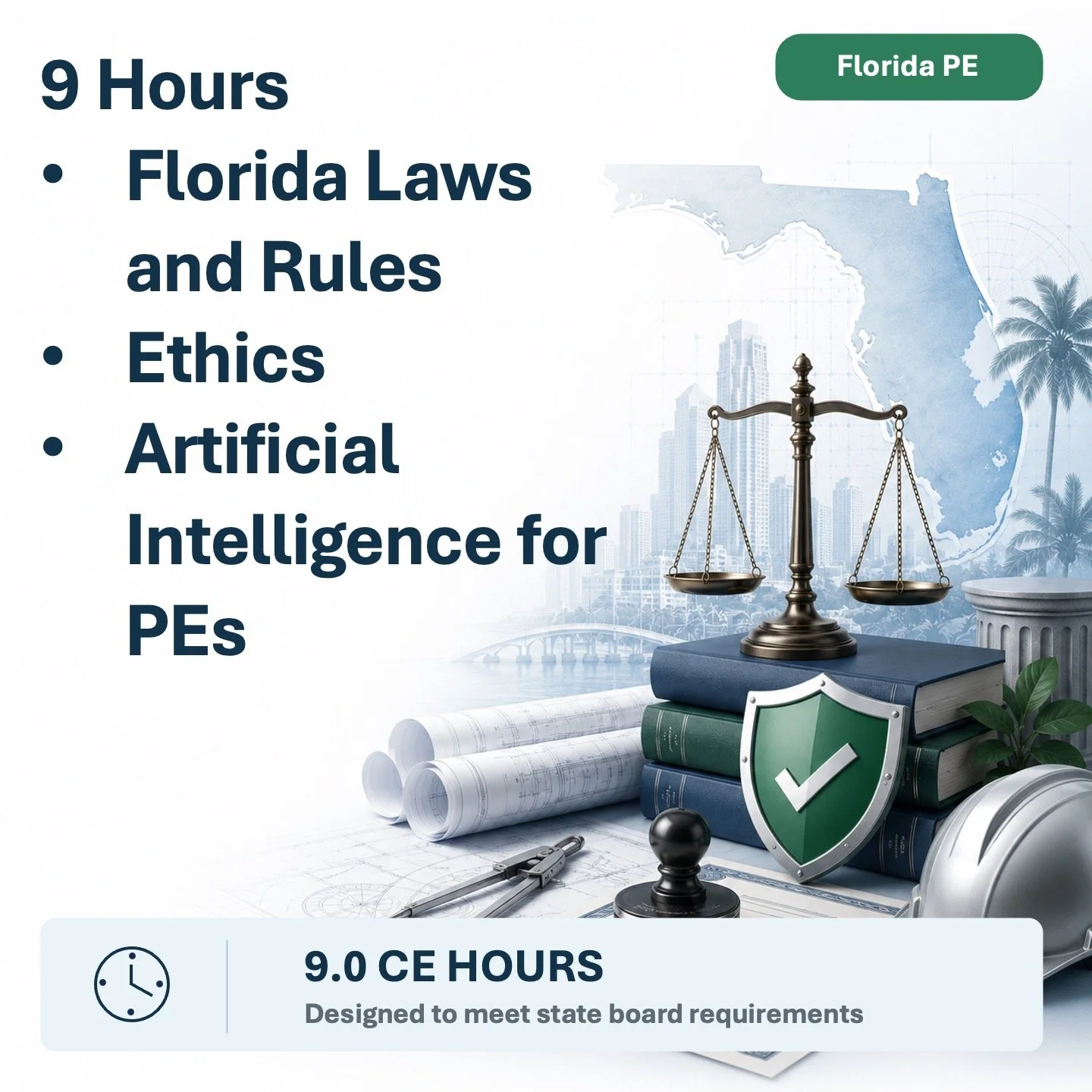
9-Hour Florida PE Continuing Education / PDH Bundle
Complete 9 hours PDH of Florida PE continuing education in one bundle. Eligible for Florida PE credit pertinent to the practice of engineering.
-
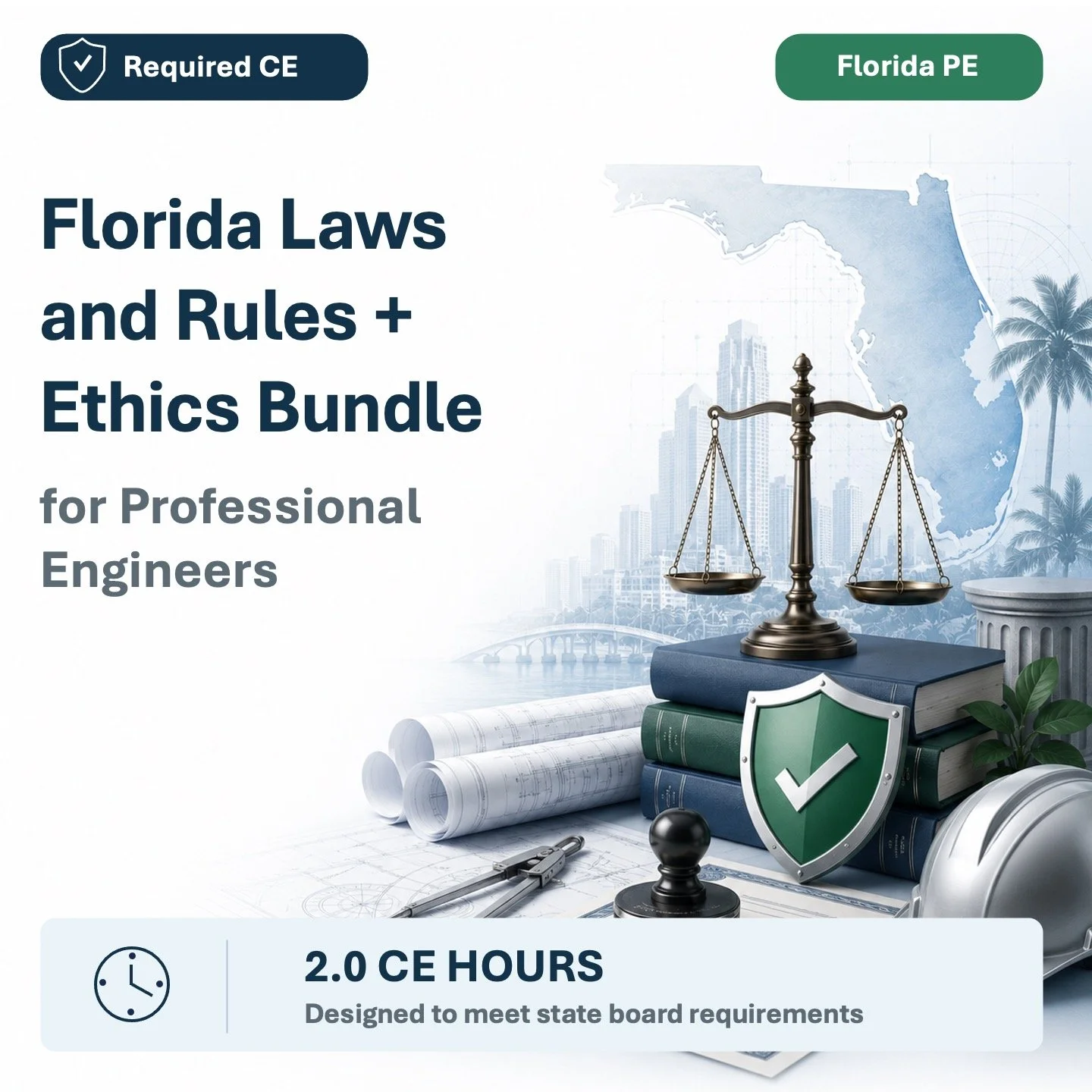
Florida Laws & Rules (1 Hour)
Engineering Ethics (1 Hour)
Leveraging Artificial Intelligence in Professional Engineering Practice (5 Hours)
AI, Automation, and the Future of Engineering Licensure (2 Hours)
18-Hour Florida PE Continuing Education / PDH Bundle
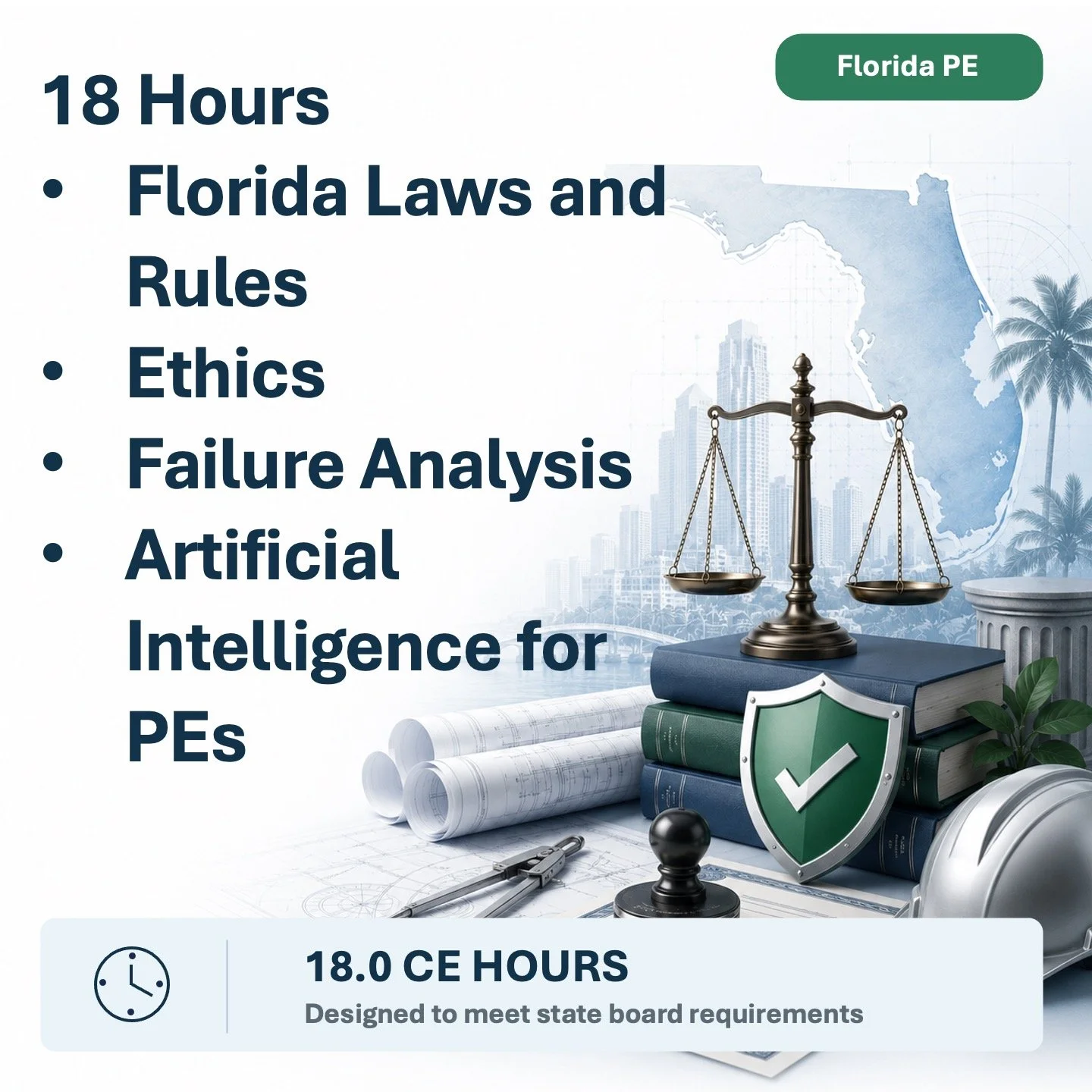
Complete 18 hours of Florida PE continuing education. Eligible for Florida PE credit pertinent to the practice of engineering.
-
Florida Laws & Rules (1 Hour)
Engineering Ethics (1 Hour)
Failure Analysis and Lessons Learned (3 Hours)
Artificial Intelligence in Engineering Practice (2 Hours)
Prompting, Documentation, and Recordkeeping for AI-Assisted Engineering Work (2 Hours)
Cybersecurity and Confidentiality Risks of AI Tools in Engineering (2 Hours)
AI, Automation, and the Future of Engineering Licensure (2 Hours)
Leveraging Artificial Intelligence in Professional Engineering Practice (5 Hours)
Florida Reporting & Certificate Information
Instant Certificate
Generated after successful completion.
DBPR Reporting
We report the Florida Laws & Rules course.
Florida Documentation
Certificate includes required completion information.
If the Florida Board of Professional Engineers rejects any course you take with us, we will issue a 100% refund immediately.
Course Syllabus
-
Provides Florida professional engineers with a practical review of the statutes and administrative rules governing engineering licensure and practice in the state. The course addresses the authority and responsibilities of the Florida Board of Professional Engineers, the legal definition and scope of engineering practice, licensure and renewal obligations, responsible charge, use of the professional engineer seal, firm authorization requirements, disciplinary grounds, and the professional duties associated with protecting the public.
Through concise instruction and applied scenarios, learners examine how Florida requirements affect common engineering decisions, including signing and sealing documents, supervising delegated work, communicating with clients and public agencies, maintaining professional records, and responding to potential violations. The course emphasizes accurate interpretation of Chapter 471, Florida Statutes, and applicable provisions of Chapter 61G15, Florida Administrative Code, while reinforcing the engineer’s continuing responsibility to exercise competent judgment and verify current requirements before acting.
-
Covers public protection, competence, responsible charge, truthful communication, and conflicts of interest. Includes four practical optional video scenarios: The Compressed Review, The Familiar Client, Unfamiliar Scope, The Completed Drawing Set, and The Report Before Closing. Followed by a final quiz.
-
Designed specifically for busy engineers, this course delivers your required ethics training in a flexible, audio-first podcast format. Ideal for listening during your daily commute, a walk, or while traveling, this course breaks down the core ethical obligations every Professional Engineer owes to the public, clients, employers, and the engineering profession. Through realistic, cross-disciplinary scenarios, you will examine real-world trade-offs between public safety, project constraints, and professional duty.
What You'll Learn
Core obligations under the PE Code of Ethics across multiple disciplines.
How to navigate competing duties to public safety, clients, and employers.
Practical strategies for identifying and managing ethical risk on active projects.
-
This course develops a practical, cross-disciplinary approach to engineering failure analysis. It explains how professional engineers can reconstruct events from evidence, distinguish failure mechanisms from deeper causal factors, apply structured root-cause methods, evaluate human and organizational contributors, and convert findings into corrective actions and transferable lessons learned. The emphasis is on disciplined failure-prevention thinking rather than blame, hindsight, or a single preferred analytical tool.
-
This course introduces professional engineers to practical uses of artificial intelligence in engineering work while emphasizing verification, judgment, and professional accountability. Topics include AI capabilities and limitations, appropriate use cases, hallucinations, hidden assumptions, source review, calculation checking, documentation, confidentiality, and responsible professional oversight.
The course is intended to help engineers use AI as a support tool for research, drafting, analysis, quality control, and workflow efficiency without treating AI output as a substitute for engineering competence, independent review, or responsible charge. -
This course examines ethical issues that arise when professional engineers use AI tools in technical, professional, or business workflows. Learners review public safety obligations, competence, truthful communication, responsible charge, confidentiality, conflicts of interest, intellectual property, overreliance on AI output, and the need to verify sources, assumptions, calculations, and conclusions.
The course is intended to help engineers recognize where AI use can create professional-risk exposure and apply ethical decision-making before relying on, sharing, or incorporating AI-assisted work. -
This course focuses on how professional engineers can use prompts, documentation practices, and records to make AI-assisted work more reliable, reviewable, and professionally defensible. Topics include prompt structure, context control, assumptions, source requests, version tracking, output review, calculation and code checks, documentation of limitations, and retention of records supporting final professional decisions.
The course is intended to help engineers improve AI-assisted workflows while maintaining clear accountability for final engineering judgment, communication, and deliverables. -
This course reviews cybersecurity, confidentiality, and data-protection risks associated with using AI tools in engineering practice. Topics include sensitive project information, client data, proprietary designs, public infrastructure information, personally identifiable information, third-party platforms, data retention, model training risks, access control, cyber hygiene, and internal AI-use policies.
The course is intended to help engineers evaluate what information should or should not be entered into AI systems and develop practical controls for protecting client, employer, project, and public-interest information. -
This course examines how AI and automation may affect engineering practice, licensure expectations, responsible charge, professional competence, supervision, documentation, and board-risk issues. Learners review the difference between task automation and professional responsibility, the limits of automated outputs, the continuing role of engineering judgment, and the importance of verification and accountability as technology changes.
The course is intended to help professional engineers adapt to AI-enabled practice while preserving the core licensure duties of competence, public protection, truthful communication, and responsible professional review. -
Covers AI career impact, tool selection, prompting, workflow design, engineering applications, verification, confidentiality, documentation, governance, and professional accountability. Includes practical exercises using ChatGPT, Claude, Gemini, and Microsoft Copilot, along with applied workshops, optional companion videos, and a final quiz.