Georgia PE Continuing Education Packages
100% Compliant with Georgia Board of Professional Engineers and Land Surveyors Requirements for the 2026 Renewal Cycle.

Don’t Risk Your PE License
Fulfill ALL 15 Hours of Georgia Board PDH Requirements
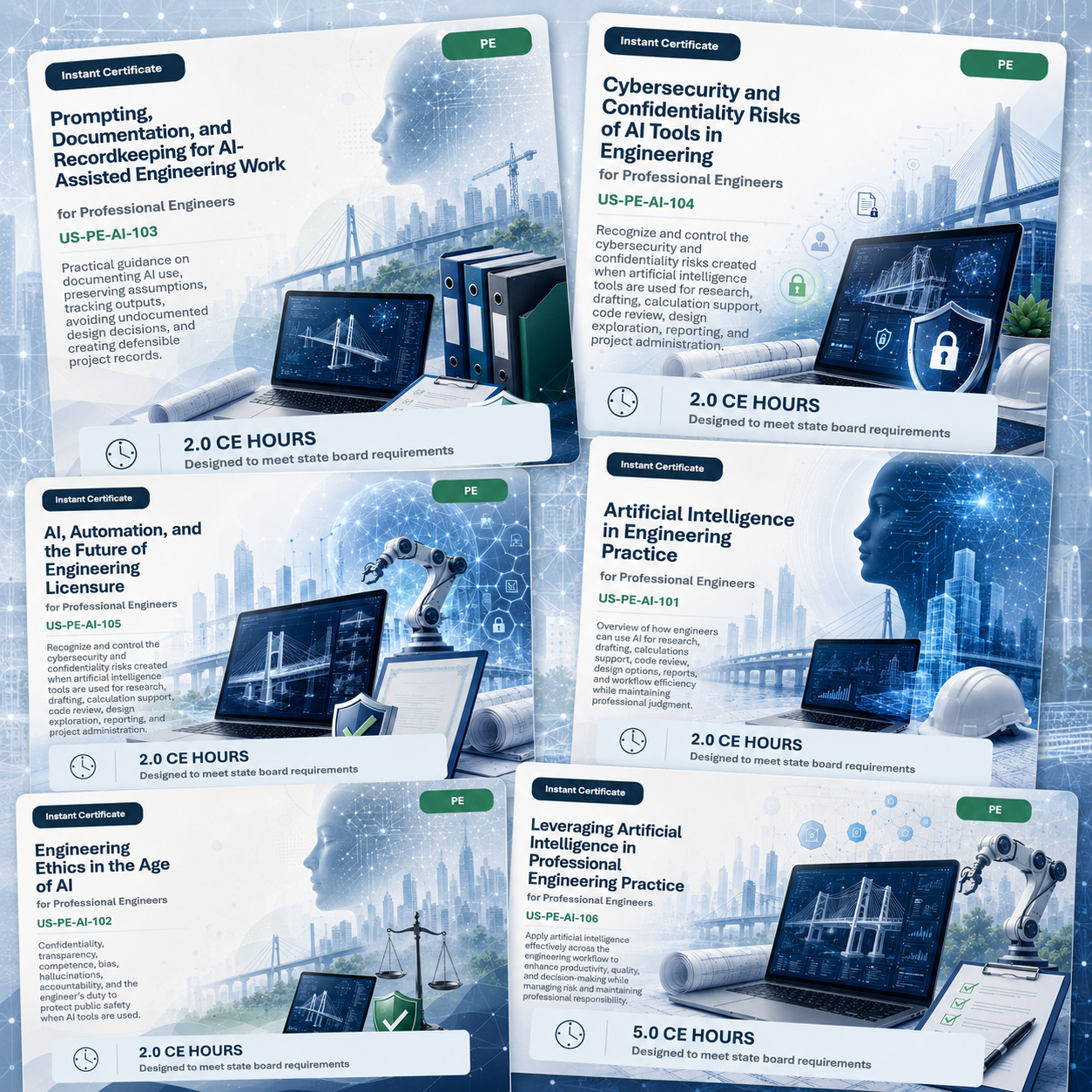
Cutting-Edge Content Built Specifically for Today’s Professional Engineer.
Includes 2 hours Engineering Ethics
The 5-Hour AI Engineering Masterclass
Master the Practical Use of AI in Professional Engineering. Save $37 compared to individual courses.
Try a 2-Hour AI for PEs starter
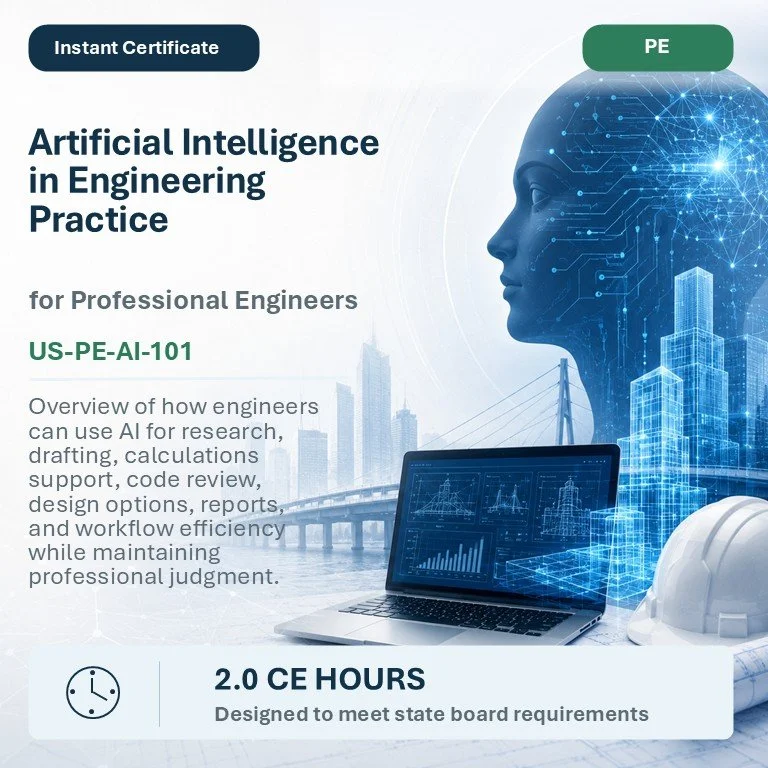
New to Artificial Intelligence? Try this 2-Hour Starter for Professional Engineers
Top Up Your PDH with This 2-Hour Course
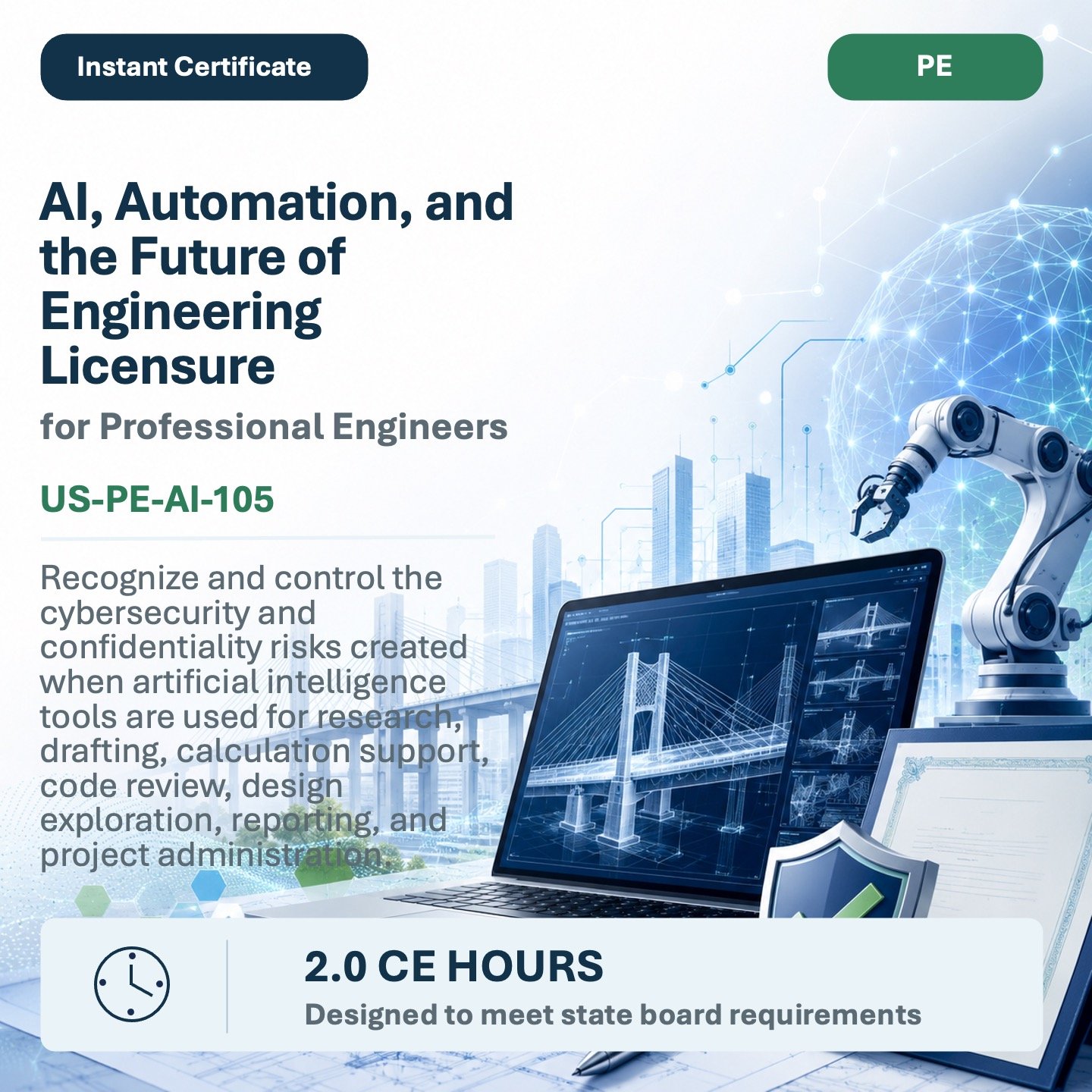
Use this course as a structured introduction to the relationship between AI, automation, engineering practice, and licensure.
Instant Certificates: certificates of completion are generated automatically the moment you pass the quiz.
Logbook Ready: Your certificates all the information required by in case you are audited by Georgia PELS Board.
Mobile-Friendly Platform: You have the option to complete the reading or audio modules on your phone, laptop, or tablet at your own pace.
If the Georgia Board of Professional Engineers and Land Surveyors rejects any course you take with us, we will issue a 100% refund immediately.
Course Syllabus
-
Combines six courses covering AI fundamentals, engineering ethics, prompting and documentation, cybersecurity and confidentiality, automation and licensure, and practical AI implementation. Learners examine engineering applications, hallucinations, verification, responsible charge, data protection, recordkeeping, tool selection, workflow design, professional accountability, and the use of platforms such as ChatGPT, Claude, Gemini, and Microsoft Copilot. Includes applied scenarios, exercises, companion videos, and a final assessment for each course.
Bundle includes the following courses:
US-PE-AI-101 Artificial Intelligence in Engineering Practice
US-PE-AI-102 Engineering Ethics in the Age of AI US-PE-AI-103 Prompting, Documentation, and Recordkeeping for AI-Assisted Engineering Work
US-PE-AI-104 Cybersecurity and Confidentiality Risks of AI Tools in Engineering US-PE-AI-105 AI, Automation, and the Future of Engineering Licensure
US-PE-AI-106 Leveraging Artificial Intelligence in Professional Engineering Practice
-
This course helps professional engineers understand how generative AI is changing engineering work and how they can adapt without surrendering professional judgment, technical accountability, or responsibility for public safety. Learners review practical workflows using ChatGPT, Claude, Gemini, and Microsoft Copilot for research, document analysis, technical communication, calculation support, project administration, quality control, and professional development.
The course is designed as a practical guide for evaluating, selecting, and applying AI tools in professional engineering workflows. It emphasizes appropriate use cases, productivity gains, effective prompting, verification of AI-assisted outputs, confidentiality protection, and continued professional accountability.
Will AI Replace Engineers? Understanding the Real Career Risk
Examine the realistic career implications of AI for professional engineers. It distinguishes between tasks, roles, and professions, emphasizing that AI is more likely to change routine production tasks than eliminate professional accountability. Learners assess where AI can accelerate work and where human judgment, field awareness, stakeholder communication, and responsible decision-making remain essential.
Choosing the Right AI Tool for the Engineering Task
Review tool selection as an engineering decision. Learners compare platforms such as ChatGPT, Claude, Gemini, and Microsoft Copilot based on task fit, source grounding, confidentiality controls, workflow integration, traceability, and cost. The module emphasizes matching the tool to the task, data classification, source requirements, and organizational controls rather than selecting a platform by brand preference.
Prompting and Workflow Design for Professional Engineers
Treat prompting as a form of lightweight technical specification writing. Learners review how to define objectives, context, constraints, sources, output format, uncertainty, and verification requirements. The module emphasizes source-bounded prompting, staged workflows, verification architecture, context management, revision control, and reusable prompt design for engineering tasks.
High-Value AI Applications Across Engineering Disciplines
Identify practical AI use cases across engineering disciplines, including research and requirements analysis, drafting and technical communication, calculation support, code review, technical automation, design-option development, trade studies, reports, specifications, quality control, and project administration. The module emphasizes that AI may improve speed and organization, but engineering conclusions still require discipline-specific competence, verification, and accountability.
Using AI Without Jeopardizing Your License, Employer, or Client
Focus on professional risk management when using AI. Topics include competence, responsible charge, confidentiality, privacy, security, intellectual property, source integrity, documentation, defensibility, organizational governance, incident response, correction, and adoption planning. The module reinforces that AI does not hold a license, owe a duty to the public, or accept disciplinary consequences; professional duties remain with the engineer.
Ten Key Points and Practical AI Use Checklist
The course closes with a practical review emphasizing that AI changes workflows but not professional accountability. Key points include choosing tools based on task and controls, using prompts as technical specifications, verifying AI-generated technical output, protecting confidential information, documenting material AI use, and retaining responsibility for competence, public protection, responsible charge, truthful communication, and final approval.
-
This course provides professional engineers with a practical overview of how artificial intelligence can support engineering practice while preserving professional judgment, technical accountability, and responsible decision-making. The course covers common AI-assisted uses, including research, drafting, calculation support, code review, design-option development, report preparation, and workflow efficiency. It emphasizes that AI tools may assist with productivity and organization, but engineers remain responsible for verifying technical content, protecting confidential information, applying relevant standards, and exercising independent professional judgment.
Course Modules
Module 1 — Introduction to Artificial Intelligence in Engineering Practice
Introduces what AI means in an engineering setting, the difference between AI-supported work and AI-delegated work, and common engineering tasks where AI may assist. The module establishes the core principle that AI can support engineering tasks, but the engineer remains responsible for judgment and final work products.
Module 2 — Practical AI Capabilities and Limitations
Reviews common AI capabilities such as summarizing documents, drafting outlines, generating checklists, comparing alternatives, supporting code, and organizing workflows. It also addresses limitations, including incorrect output, invented references, misstated requirements, missing assumptions, outdated information, and context errors.
Module 3 — AI for Engineering Research and Technical Information Review
Covers how AI can support research orientation, issue spotting, technical summaries, and review of codes, standards, regulations, and technical information. The module emphasizes that AI-generated research must be verified against controlling sources, applicable editions, jurisdictions, project facts, and authoritative references.
Module 4 — AI for Drafting, Editing, and Technical Communication
Explains appropriate uses of AI for drafting emails, reports, summaries, action items, and technical explanations. The module emphasizes objectivity, accuracy, scope control, and the need to prevent AI-generated wording from inventing facts, overstating certainty, omitting limitations, or changing technical meaning.
Module 5 — AI as Calculation Support
Reviews how AI can assist with calculation planning, variable identification, formula organization, spreadsheet support, unit checks, and reasonableness prompts. The module stresses that AI-assisted calculations require independent verification of inputs, formulas, assumptions, units, intermediate steps, and project applicability.
Module 6 — AI for Code Review and Technical Automation
Addresses AI support for reviewing scripts, spreadsheets, macros, data-processing routines, control logic, and technical automation. Topics include syntax review, test-case generation, documentation, version control, validation, engineering logic, and peer review where code affects technical conclusions or deliverables.
Module 7 — AI for Design Options and Engineering Judgment
Explains how AI can help brainstorm alternatives, organize constraints, compare conceptual options, and prepare preliminary decision matrices. The module emphasizes that AI-generated design options are prompts for professional evaluation, not final engineering decisions.
Module 8 — AI for Reports, Specifications, and Deliverables
Reviews AI use in organizing reports, drafting executive summaries, improving consistency, checking scope alignment, and supporting specification development. The module emphasizes final deliverable review for accuracy, completeness, assumptions, limitations, coordination with drawings and specifications, and avoidance of unsupported claims.
Module 9 — Workflow Efficiency and Quality-Control Applications
Covers AI-assisted workflow improvements such as agendas, meeting summaries, action-item lists, review logs, document consistency checks, lessons learned, and quality-control prompts. The module distinguishes efficiency from accountability and reinforces that AI may support QC but does not replace qualified technical review.
Module 10 — Risk Management, Confidentiality, and Data Governance
Reviews risks involving confidential client information, proprietary designs, nonpublic facility data, security-sensitive information, personal data, trade secrets, bid information, and internal business records. The module also covers approved tools, access controls, retention practices, AI-use policies, and intellectual-property concerns.
Module 11 — Professional Responsibility When Using AI
Connects AI use to professional duties involving competence, responsible charge, accountability, public protection, truthful communication, and objective reporting. The module emphasizes that AI tools do not hold a license, assume responsible charge, sign or seal documents, or accept professional responsibility.
Module 12 — Practical AI-Use Framework for Engineers
Provides a structured framework for responsible AI use: define the task, control the input, review the output, verify technical content, document when appropriate, and take responsibility for the final work product. The module closes with practical decision prompts for engineers using AI in professional workflows.
-
This course examines how artificial intelligence, automation, and digital engineering tools may affect professional engineering practice, licensure expectations, responsible charge, supervision, documentation, and professional accountability. The course focuses on practical issues that licensed engineers are likely to encounter as AI-assisted workflows become more common in research, design support, drafting, analysis, communication, quality control, and project administration.
Learners review the difference between task automation and professional responsibility, the limits of automated outputs, the continuing role of engineering judgment, and the importance of verification, documentation, confidentiality, and final professional review. The course treats AI as a support tool, not as a replacement for professional competence or the licensed engineer’s responsibility for final engineering work.
Course Modules
Module 1 — AI, Automation, and the Changing Engineering Workflow
Introduces how AI and automation are being used to support engineering tasks such as research, drafting, code assistance, calculation checks, data analysis, report preparation, and project communication. The module emphasizes that efficiency gains do not transfer professional responsibility away from the engineer.
Module 2 — Licensure, Competence, and Responsible Charge in an Automated Environment
Reviews how traditional licensure concepts apply when AI tools assist with engineering work. Topics include competence, supervision, responsible charge, review of work prepared by others, and the need for meaningful control over professional decisions.
Module 3 — Human Judgment, Verification, and Quality Control
Focuses on the engineer’s duty to verify AI-assisted or automated outputs before relying on them. Topics include hallucinations, hidden assumptions, incomplete context, outdated information, calculation errors, code errors, and the need to validate conclusions against authoritative sources and engineering principles.
Module 4 — Documentation, Records, and Defensible Use of AI Tools
Explains how engineers can document AI-assisted workflows in a practical and reviewable manner. Topics include prompts, assumptions, source checks, version history, calculation validation, review notes, limitations, and records that support final professional decisions.
Module 5 — Confidentiality, Data Governance, Cybersecurity, and Intellectual Property
Reviews risks associated with entering project information into AI systems, including client confidentiality, proprietary designs, public infrastructure information, personally identifiable information, platform data retention, access controls, and internal AI-use policies.
Module 6 — Supervision, Delegation, and Organizational Use of AI
Examines how AI may affect delegation of work to staff, review of subordinate work, firm-level procedures, software governance, and quality management. The module emphasizes that AI tools may assist teams but do not eliminate the engineer’s obligation to supervise, review, and exercise independent judgment.
Module 7 — Future Practice, Board-Risk Scenarios, and Professional Adaptation
Considers how AI and automation may influence future expectations for engineering practice, licensure, documentation, and professional conduct. Learners review practical scenarios involving overreliance, insufficient review, unclear records, confidentiality failures, and pressure to approve AI-assisted work without adequate verification.
Module 8 — Course Review and Practical Implementation Framework
Provides a final framework for responsible AI use in engineering practice. Learners review when AI use may be appropriate, what must be verified, what should be documented, what information should be protected, and when the engineer should slow down, escalate, or decline to rely on AI-assisted output.