
Louisiana PE Continuing Education Courses & Bundles
100% Compliant with Louisiana Professional Engineering and Land Surveying Board (LAPELS) Requirements for the 2026 Renewal Cycle | LicensePoint Education
-
Louisiana PE must complete 15 PDHs per calendar year ( 30 PDHs in the 2-year renewal cycle) in engineering-related acceptable activities.
1 Hour: Professional Ethics
For PEs who design buildings, at least 4 PDH per calendar year must be earned in Life Safety Code, building codes, and/or Americans with Disabilities Act Accessibility Guidelines.
Louisiana PE Ethics Course - 1 Hour
US-PE-ET-101 Engineering Ethics Fundamentals for Professional Engineers
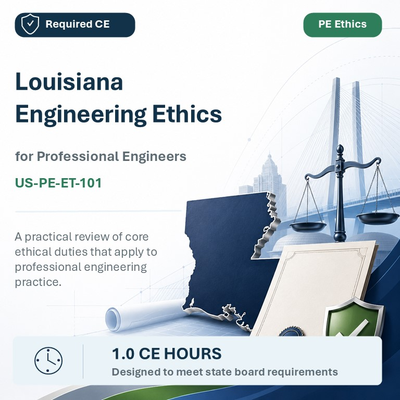
Designed to meet Louisiana state board requirements for Ethics.
Louisiana PE Ethics Course in Audio Format
US-PE-ET-103 - Audio Podcast Ethics for Professional Engineers
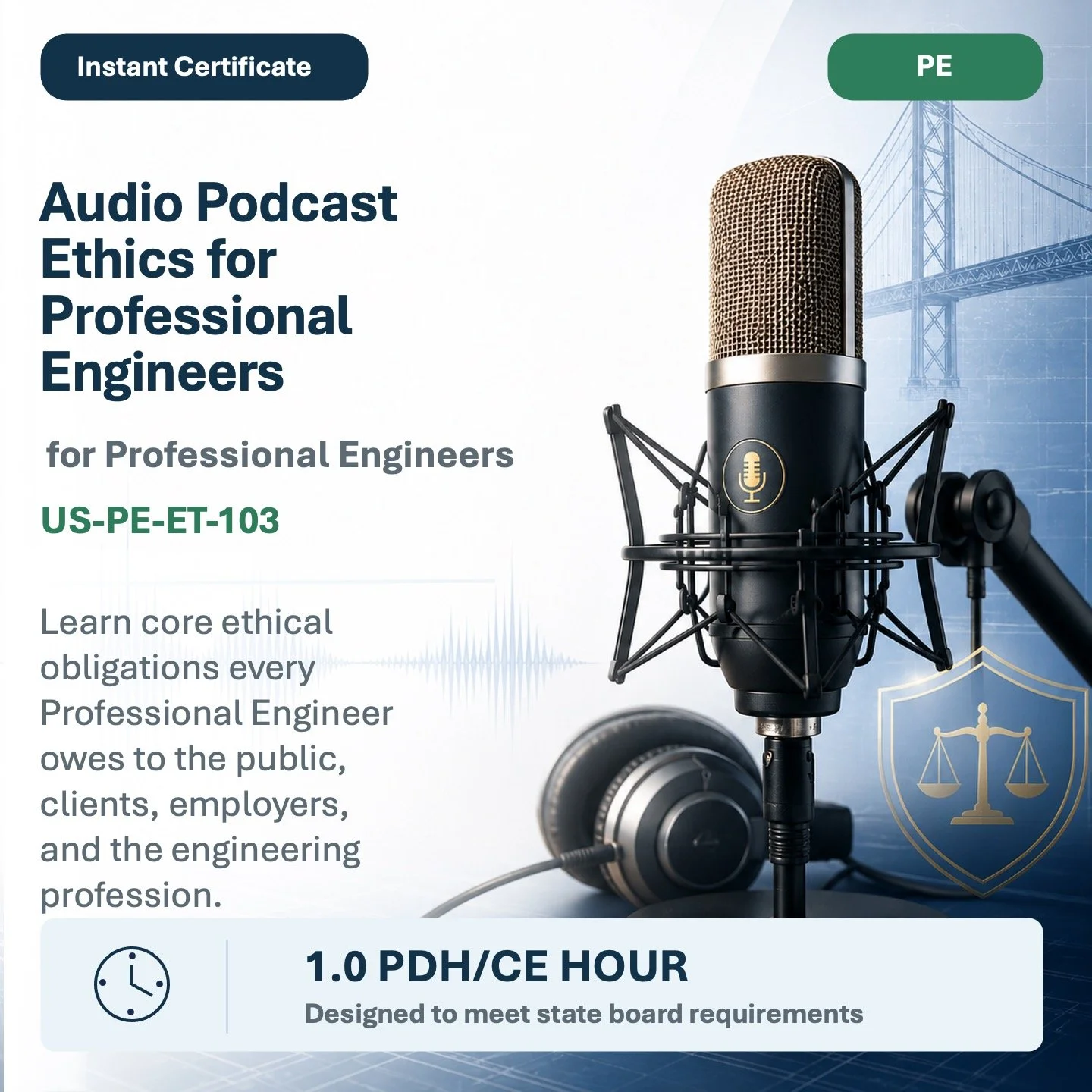
Designed specifically for busy engineers, these courses delivers your required ethics training in a flexible, audio-first podcast format.

Fulfill your mandatory Louisiana Ethics Course On the Go. Listen from the course web page or your favorite podcast platform.
Louisiana PE Continuing Education Courses
Knock out all your required hours with this 15-hour PE bundle that includes Ethics
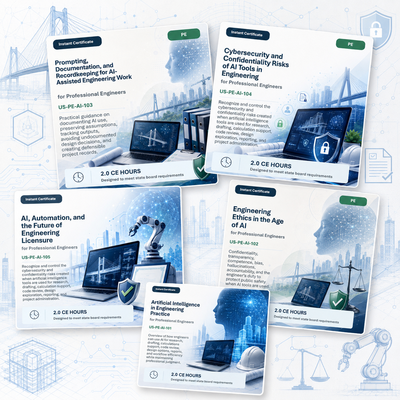
Harness the Power of AI in Professional Engineering. Safely, Ethically, and on Your Schedule
Fulfill ALL 15 Hours of Louisiana Board CE Requirements with Cutting-Edge Content Built Specifically for Today's Professional Engineer.
Includes 2 Hours Engineering Ethics
Louisiana PE Continuing Education Course - 5 Hours
The 5-Hour AI Engineering Masterclass
US-PE-AI-106 Leveraging Artificial Intelligence in Professional Engineering Practice
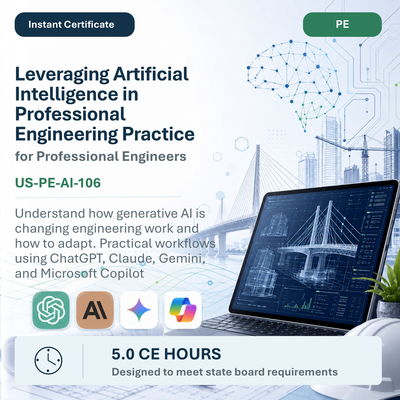
Master the Practical Use of AI in Professional Engineering. Save $37 compared to individual courses.
Louisiana PE Continuing Education Course - 2 Hours
Try a 2-Hour AI for PEs starter
US-PE-AI-101 Artificial Intelligence in Engineering Practice
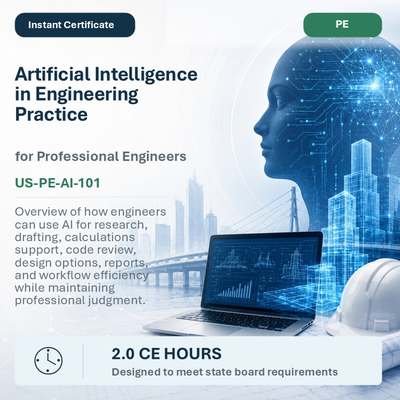
Top-up with 2-hour individual course.
Instant Certificates: certificates of completion are generated automatically the moment you pass the quiz.
Logbook Ready: Your certificates all the information required by in case you are audited by LAPELS.
Mobile-Friendly Platform: You have the option to complete the reading or audio modules on your phone, laptop, or tablet at your own pace.

If the Louisiana Professional Engineering and Land Surveying Board rejects any course you take with us, we will issue a 100% refund immediately.
Reviews
-
"A PE course with videos! I appreciated the change of style. Content was very good" Paul G., P.E., 6/30/2026
"this course had really good case studies in the videos" Adam N., P.E., 7/13/2026
"Engaging style with fresh content for engineering ethics" James S., P.E., 7/28/2026
Course Syllabus
-
US-PE-ET-101 — Engineering Ethics Fundamentals for Professional Engineers
Covers public protection, competence, responsible charge, truthful communication, and conflicts of interest. Includes four practical video scenarios: The Compressed Review, The Familiar Client, Unfamiliar Scope, The Completed Drawing Set, and The Report Before Closing. Followed by a final quiz.
-
US-PE-ET-103 - Audio Podcast Ethics for Professional Engineers
Description
Designed specifically for busy engineers, this course delivers your required ethics training in a flexible, audio-first podcast format. Ideal for listening during your daily commute, a walk, or while traveling, this course breaks down the core ethical obligations every Professional Engineer owes to the public, clients, employers, and the engineering profession. Through realistic, cross-disciplinary scenarios, you will examine real-world trade-offs between public safety, project constraints, and professional duty.
What You'll Learn
Core obligations under the PE Code of Ethics across multiple disciplines.
How to navigate competing duties to public safety, clients, and employers.
Practical strategies for identifying and managing ethical risk on active projects.
-
Combines six courses covering AI fundamentals, engineering ethics, prompting and documentation, cybersecurity and confidentiality, automation and licensure, and practical AI implementation. Learners examine engineering applications, hallucinations, verification, responsible charge, data protection, recordkeeping, tool selection, workflow design, professional accountability, and the use of platforms such as ChatGPT, Claude, Gemini, and Microsoft Copilot. Includes applied scenarios, exercises, companion videos, and a final assessment for each course.
Bundle includes the following courses:
US-PE-AI-101 Artificial Intelligence in Engineering Practice
US-PE-AI-102 Engineering Ethics in the Age of AI US-PE-AI-103 Prompting, Documentation, and Recordkeeping for AI-Assisted Engineering Work
US-PE-AI-103 - Prompting, Documentation, and Recordkeeping for AI-Assisted Engineering Work
US-PE-AI-104 Cybersecurity and Confidentiality Risks of AI Tools in Engineering US-PE-AI-105 AI, Automation, and the Future of Engineering Licensure
US-PE-AI-105 - AI, Automation, and the Future of Engineering Licensure
US-PE-AI-106 Leveraging Artificial Intelligence in Professional Engineering Practice
-
This course helps professional engineers understand how generative AI is changing engineering work and how they can adapt without surrendering professional judgment, technical accountability, or responsibility for public safety. Learners review practical workflows using ChatGPT, Claude, Gemini, and Microsoft Copilot for research, document analysis, technical communication, calculation support, project administration, quality control, and professional development.
The course is designed as a practical guide for evaluating, selecting, and applying AI tools in professional engineering workflows. It emphasizes appropriate use cases, productivity gains, effective prompting, verification of AI-assisted outputs, confidentiality protection, and continued professional accountability.
Will AI Replace Engineers? Understanding the Real Career Risk
Examine the realistic career implications of AI for professional engineers. It distinguishes between tasks, roles, and professions, emphasizing that AI is more likely to change routine production tasks than eliminate professional accountability. Learners assess where AI can accelerate work and where human judgment, field awareness, stakeholder communication, and responsible decision-making remain essential.
Choosing the Right AI Tool for the Engineering Task
Review tool selection as an engineering decision. Learners compare platforms such as ChatGPT, Claude, Gemini, and Microsoft Copilot based on task fit, source grounding, confidentiality controls, workflow integration, traceability, and cost. The module emphasizes matching the tool to the task, data classification, source requirements, and organizational controls rather than selecting a platform by brand preference.
Prompting and Workflow Design for Professional Engineers
Treat prompting as a form of lightweight technical specification writing. Learners review how to define objectives, context, constraints, sources, output format, uncertainty, and verification requirements. The module emphasizes source-bounded prompting, staged workflows, verification architecture, context management, revision control, and reusable prompt design for engineering tasks.
High-Value AI Applications Across Engineering Disciplines
Identify practical AI use cases across engineering disciplines, including research and requirements analysis, drafting and technical communication, calculation support, code review, technical automation, design-option development, trade studies, reports, specifications, quality control, and project administration. The module emphasizes that AI may improve speed and organization, but engineering conclusions still require discipline-specific competence, verification, and accountability.
Using AI Without Jeopardizing Your License, Employer, or Client
Focus on professional risk management when using AI. Topics include competence, responsible charge, confidentiality, privacy, security, intellectual property, source integrity, documentation, defensibility, organizational governance, incident response, correction, and adoption planning. The module reinforces that AI does not hold a license, owe a duty to the public, or accept disciplinary consequences; professional duties remain with the engineer.
Ten Key Points and Practical AI Use Checklist
The course closes with a practical review emphasizing that AI changes workflows but not professional accountability. Key points include choosing tools based on task and controls, using prompts as technical specifications, verifying AI-generated technical output, protecting confidential information, documenting material AI use, and retaining responsibility for competence, public protection, responsible charge, truthful communication, and final approval.
-
This course introduces professional engineers to practical uses of AI in engineering workflows while emphasizing professional judgment, verification, confidentiality, and accountability. Learners review how AI can support research, drafting, calculations, code review, design-option development, reports, specifications, quality control, and workflow efficiency.
The course also addresses AI limitations, including inaccurate outputs, hallucinated references, hidden assumptions, context errors, and overreliance. Engineers learn a practical framework for responsible AI use: define the task, control inputs, review outputs, verify technical content, document when appropriate, and retain responsibility for final engineering decisions.