
Michigan PE Continuing Education Credit Requirements
Michigan professional engineers are regulated by the Michigan Department of Licensing and Regulatory Affairs, Bureau of Professional Licensing, with the Board of Professional Engineers serving as the profession-specific board. Michigan’s current professional-engineer administrative rules became effective May 8, 2025, and the state licensing guide was revised January 26, 2026.
Renewal Frequency and Expiration
Michigan professional engineer licenses renew on a 2-year cycle. The renewal application may be submitted through MiPLUS beginning 90 days before the expiration date shown for the current license. Michigan’s official materials do not identify one statewide calendar expiration date for every PE license; licensees should use the expiration date associated with their individual license record.
Michigan provides a 60-day grace period after expiration during which the license may still be renewed without completing the relicensure process. A renewal completed during the grace period is subject to an additional late fee. The grace period does not extend the continuing-education completion period: the required education must have been completed before the license expiration date. A licensee who did not complete the requirements by expiration must apply for relicensure.
Total Continuing Education Requirement
A Michigan professional engineer renewing a license must complete 30 continuing education credit hours during the 2-year period immediately preceding the license expiration date. The education must fall within activities and subjects recognized by the current administrative rules.
Professional Ethics Requirement
At least 2 of the required 30 hours must be earned in an activity focused on professional ethics related to engineering. The ethics activity does not have to focus specifically on Michigan statutes or administrative rules.
Complete online, self-paced courses engineered specifically to satisfy Michigan criteria, including the mandatory Ethics requirement. Certificate automatically issued upon completion
Complete Michigan PE Continuing Education Online
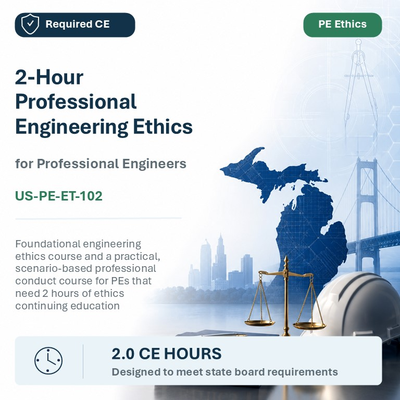
Engineering Ethics
2 PDH
Mandatory Ethics Requirement
Leveraging AI in Engineering Practice
5 PDH
Technical Area of Practice

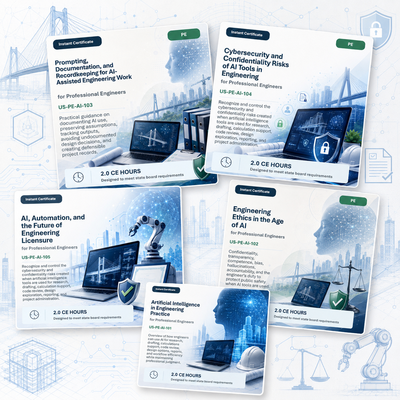
15-Hour AI & Ethics Bundle
15 PDH
Earn 15 of Michigan’s Required Hours, Including Ethics
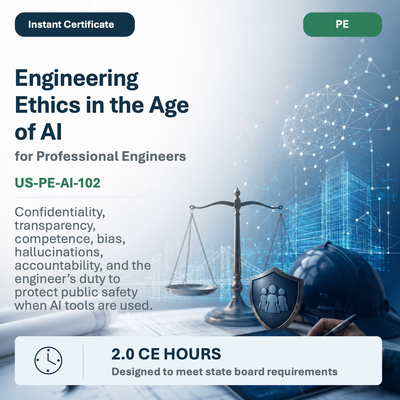
Engineering Ethics in the Age of AI
2 PDH
Ethics OR Technical Area of Practice
Certificate issued immediately upon completion
Try Our Audio Podcast Format for PE Ethics

Fulfill your mandatory Michigan Ethics Course.
US-PE-ET-105 Audio Podcast Engineering Ethics Fundamentals, Board-Action Scenarios, Major News Failures, and Modern AI Ethics Risks
Listen from the course web page or your favorite podcast platform.

Designed specifically for busy engineers, these courses delivers your required ethics training in a flexible, audio-first podcast format.
Qualifying Activities
Michigan Rule R 339.16041 recognizes the following activities, subject to the stated credit calculations, limits, and documentation requirements:
In-person or online professional-engineering programs approved or offered for continuing-education credit by another state engineering board, a professional engineering association, organization or society, NCEES, or ABET. Credit is based on the amount approved by the sponsor or approving entity.
Passing an engineering-related academic course at a college or university that offers an EAC/ABET- or CEAB-accredited engineering program: 15 hours per semester credit or 10 hours per quarter credit.
Attending an engineering-related seminar, in-house course, workshop, or professional or technical presentation: 1 hour for each 50 minutes of attendance.
Teaching, instructing, or presenting on an engineering-related subject: 2 hours for each 50 minutes, limited to 12 hours per renewal period.
Publishing a peer-reviewed engineering paper, article, or book: 6 hours per publication, limited to 18 hours per renewal period. The same work cannot receive repeat credit merely because it is published more than once.
Serving as a voting member of a state or national engineering-related committee, board, council, or association while participating in at least 50% of its regularly scheduled meetings: 3 hours per year, limited to 6 hours per renewal period.
Attending a complete Michigan Board of Professional Engineers meeting and obtaining the required department verification form: 1 hour per meeting, limited to 6 hours per renewal period.
Serving as a school-sponsored mentor to an engineering student when mentoring is outside the licensee’s regular job description: 4 hours per activity, limited to 8 hours per renewal period.
Participating in a company-sponsored or hosted seminar or training designed to enhance professional development in the licensee’s area of practice: 1 hour for each 50 minutes.
Studying an engineering-related article in a peer-reviewed, professional, or scientific journal: 2 hours per article, limited to 4 hours per renewal period.
Obtaining a patent related to professional engineering: 10 hours per patent, limited to 20 hours per renewal period.
Substantially identical programs or activities cannot receive duplicate credit during the same renewal period.
Online Courses, Self-Study, and Webinars
Michigan expressly recognizes qualifying in-person and online education. Online courses and webinars are not assigned a separate overall percentage or hour cap in the current rule, but they must fit an approved activity category and be supported by the documentation required for that category.
Independent study is recognized in the specific form of studying qualifying peer-reviewed, professional, or scientific journal articles, with 2 hours per article and a 4-hour renewal-period maximum.
Provider and Course Approval
Michigan does not establish a general process through which every PE course or provider is individually preapproved by the department. For the standard continuing-education-program category, however, the program must be approved or offered for credit by one of the entities identified in R 339.16041: another state engineering board, a professional engineering association, organization or society, NCEES, or ABET. Other qualifying activities are evaluated under their applicable rule category and documentation standard.
Licensees remain responsible for determining that an activity qualifies and for maintaining evidence sufficient to substantiate the credit if audited.
Michigan Ethics, AI, and Technical course options
Carryover
Michigan requires the 30 hours to be completed during the 2-year period immediately preceding license expiration. The current rule does not provide for carrying excess hours from an earlier renewal period into a later one.
Documentation and Record Retention
A licensee must retain continuing-education documentation for 4 years after filing the renewal application. Documentation varies by activity and may include:
Certificates of completion showing the licensee’s name, hours earned, sponsor name and contact information, program title, and completion date.
Academic transcripts.
Presentation notices, attendance records, or employer-issued training certificates.
Teaching verification.
Publication copies or acceptance letters.
Committee-service verification.
Board-meeting attendance forms.
School-issued mentoring verification.
Journal citation and reading-date records.
Patent grant documentation.
Records ordinarily are retained by the licensee rather than submitted with the routine renewal application.
Renewal Certification and Audit
Submitting the renewal application constitutes the licensee’s certification that the continuing-education requirements have been satisfied. The licensee must also accept the online renewal attestation confirming that the requirements were completed and that the renewal information is true and complete.
Licensees are subject to audit and must provide supporting documentation when requested by the department.
Meet Your General Technical PE Hour Requirements
Frequently Asked Questions
-
A Michigan professional engineer renewing a license must complete 30 continuing education credit hours during the 2-year period immediately preceding the license expiration date. At least 2 of the 30 hours must focus on professional ethics related to engineering.
-
Yes. Michigan Rule R 339.16041 expressly allows qualifying in-person or online continuing education. The activity must satisfy one of the rule’s approved activity categories, and the licensee must retain the required proof in case of audit.
-
Michigan’s rule does not establish a general state preapproval process for every course or provider. For the standard program category, the program must be approved or offered for continuing education credit by another state engineering board, a professional engineering association, organization, or society, NCEES, or ABET. Licensees remain responsible for documenting that the activity qualifies.
-
Keep supporting continuing education documentation for 4 years after filing the renewal application. The renewal application serves as the licensee’s certification of compliance; records are retained for audit and must be provided if requested by the department.
Course Syllabus
-
Combines six courses covering AI fundamentals, engineering ethics, prompting and documentation, cybersecurity and confidentiality, automation and licensure, and practical AI implementation. Learners examine engineering applications, hallucinations, verification, responsible charge, data protection, recordkeeping, tool selection, workflow design, professional accountability, and the use of platforms such as ChatGPT, Claude, Gemini, and Microsoft Copilot. Includes applied scenarios, exercises, companion videos, and a final assessment for each course.
Bundle includes the following courses:
US-PE-AI-101 Artificial Intelligence in Engineering Practice
US-PE-AI-102 Engineering Ethics in the Age of AI
US-PE-AI-103 Prompting, Documentation, and Recordkeeping for AI-Assisted Engineering Work
US-PE-AI-104 Cybersecurity and Confidentiality Risks of AI Tools in Engineering
US-PE-AI-105 AI, Automation, and the Future of Engineering Licensure
US-PE-AI-106 Leveraging Artificial Intelligence in Professional Engineering Practice
-
Covers public protection, competence, responsible charge, truthful communication, and conflicts of interest. Includes four practical video scenarios: The Compressed Review, The Familiar Client, Unfamiliar Scope, The Completed Drawing Set, and The Report Before Closing. Followed by a final quiz.
-
US-PE-ET-105 Audio Podcast Engineering Ethics Fundamentals, Board-Action Scenarios, Major News Failures, and Modern AI Ethics Risks
Get your complete ethics PDH requirement covered in one convenient, audio-first course. Built for engineers who want to learn on the move, whether walking, commuting, or waiting at an airport. This comprehensive course combines foundational ethical principles with real-world enforcement scenarios. You will explore core duties to the public, client, and profession, then transition into deep-dive analyses of board disciplinary actions, landmark news failures, and modern AI ethics risks.
-
This course helps professional engineers understand how generative AI is changing engineering work and how they can adapt without surrendering professional judgment, technical accountability, or responsibility for public safety. Learners review practical workflows using ChatGPT, Claude, Gemini, and Microsoft Copilot for research, document analysis, technical communication, calculation support, project administration, quality control, and professional development.
The course is designed as a practical guide for evaluating, selecting, and applying AI tools in professional engineering workflows. It emphasizes appropriate use cases, productivity gains, effective prompting, verification of AI-assisted outputs, confidentiality protection, and continued professional accountability.
Will AI Replace Engineers? Understanding the Real Career Risk
Examine the realistic career implications of AI for professional engineers. It distinguishes between tasks, roles, and professions, emphasizing that AI is more likely to change routine production tasks than eliminate professional accountability. Learners assess where AI can accelerate work and where human judgment, field awareness, stakeholder communication, and responsible decision-making remain essential.
Choosing the Right AI Tool for the Engineering Task
Review tool selection as an engineering decision. Learners compare platforms such as ChatGPT, Claude, Gemini, and Microsoft Copilot based on task fit, source grounding, confidentiality controls, workflow integration, traceability, and cost. The module emphasizes matching the tool to the task, data classification, source requirements, and organizational controls rather than selecting a platform by brand preference.
Prompting and Workflow Design for Professional Engineers
Treat prompting as a form of lightweight technical specification writing. Learners review how to define objectives, context, constraints, sources, output format, uncertainty, and verification requirements. The module emphasizes source-bounded prompting, staged workflows, verification architecture, context management, revision control, and reusable prompt design for engineering tasks.
High-Value AI Applications Across Engineering Disciplines
Identify practical AI use cases across engineering disciplines, including research and requirements analysis, drafting and technical communication, calculation support, code review, technical automation, design-option development, trade studies, reports, specifications, quality control, and project administration. The module emphasizes that AI may improve speed and organization, but engineering conclusions still require discipline-specific competence, verification, and accountability.
Using AI Without Jeopardizing Your License, Employer, or Client
Focus on professional risk management when using AI. Topics include competence, responsible charge, confidentiality, privacy, security, intellectual property, source integrity, documentation, defensibility, organizational governance, incident response, correction, and adoption planning. The module reinforces that AI does not hold a license, owe a duty to the public, or accept disciplinary consequences; professional duties remain with the engineer.
Ten Key Points and Practical AI Use Checklist
The course closes with a practical review emphasizing that AI changes workflows but not professional accountability. Key points include choosing tools based on task and controls, using prompts as technical specifications, verifying AI-generated technical output, protecting confidential information, documenting material AI use, and retaining responsibility for competence, public protection, responsible charge, truthful communication, and final approval.
-
Provide engineers with a practical framework for applying professional ethics to the
use of artificial intelligence in engineering practice. The course connects long-standing duties of protecting public safety, practicing within competence, being objective and truthful, safeguarding confidential information, avoiding conflicts of interest, and accepting responsibility for professional work—to emerging AI-related concerns such as inaccurate output, automation bias, hidden assumptions, data leakage, biased models, unclear authorship, insufficient disclosure, and overreliance on tools that cannot exercise professional judgment.
Training multiple engineers? Ask about group enrollment.