
South Carolina PE Continuing Education Requirements
South Carolina professional engineers are regulated by the South Carolina State Board of Registration for Professional Engineers and Surveyors, a division of the South Carolina Department of Labor, Licensing and Regulation. The Board calls its continuing-education program Continuing Professional Competency, or CPC.
Renewal Frequency and Deadline
South Carolina professional engineer licenses renew biennially. For the current renewal cycle, the deadline to renew a 2026–2028 individual license without a late penalty is July 31, 2026.
The Board has established the following late-renewal schedule:
Renewals postmarked August 1–31, 2026 are subject to a $14 late fee for an individual license.
Renewals postmarked September 1–30, 2026 are subject to an additional late fee.
After September 30, 2026, the licensee may no longer practice under the expired license and must complete the reinstatement process.
The renewal date and late-renewal instructions published by the Board should control for the current cycle.
Total Continuing Education Requirement
A South Carolina professional engineer generally must complete 30 professional development hours (PDH) during each biennial renewal period. For the 2026 renewal, the applicable reporting period is July 1, 2024, through June 30, 2026.
A licensee may earn no more than 12 PDH in one calendar day.
Subject-Matter Requirements
South Carolina does not establish a separate mandatory ethics-hour requirement for professional engineers in Article 6 of Chapter 49.
Courses and activities must have a clear purpose and objective that maintain, improve, or expand skills and knowledge relevant to the licensee’s field of practice. Regular employment duties do not qualify.
Effective July 1, 2022, no more than 50% of the PDH claimed during a renewal cycle may be earned in business or nontechnical subject matter. Therefore, at least 15 of the required 30 PDH ordinarily must concern technical or professionally relevant subject matter rather than business or nontechnical topics.
Get fully compliant with our 100% online, self-paced courses engineered specifically to satisfy South Carolina criteria. Certificate automatically issued upon completion
Explore Courses for Your South Carolina Biennial PDH Requirements
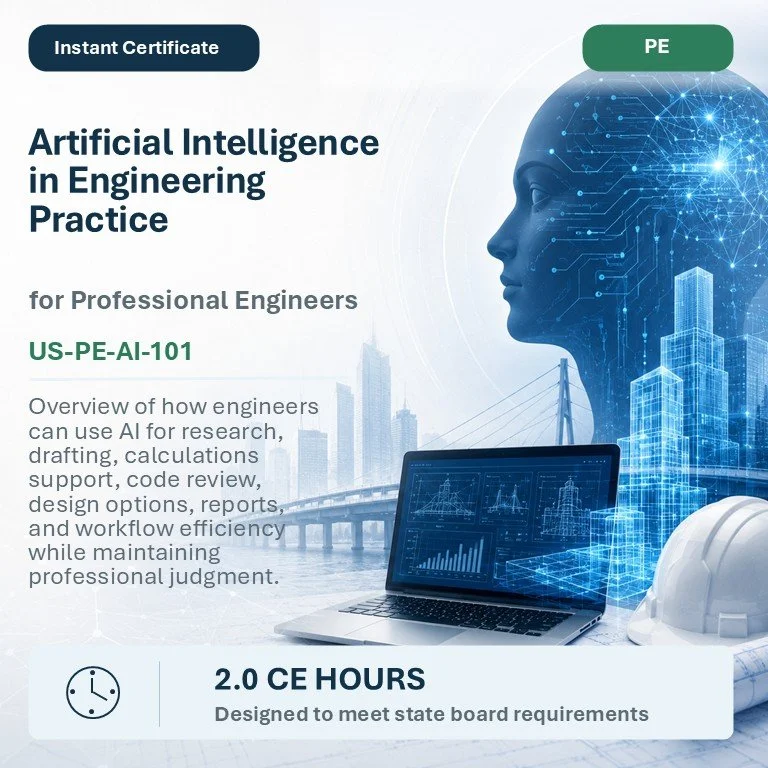
AI Primer
2 PDH
Upgrade Your Artificial Intelligence Skills
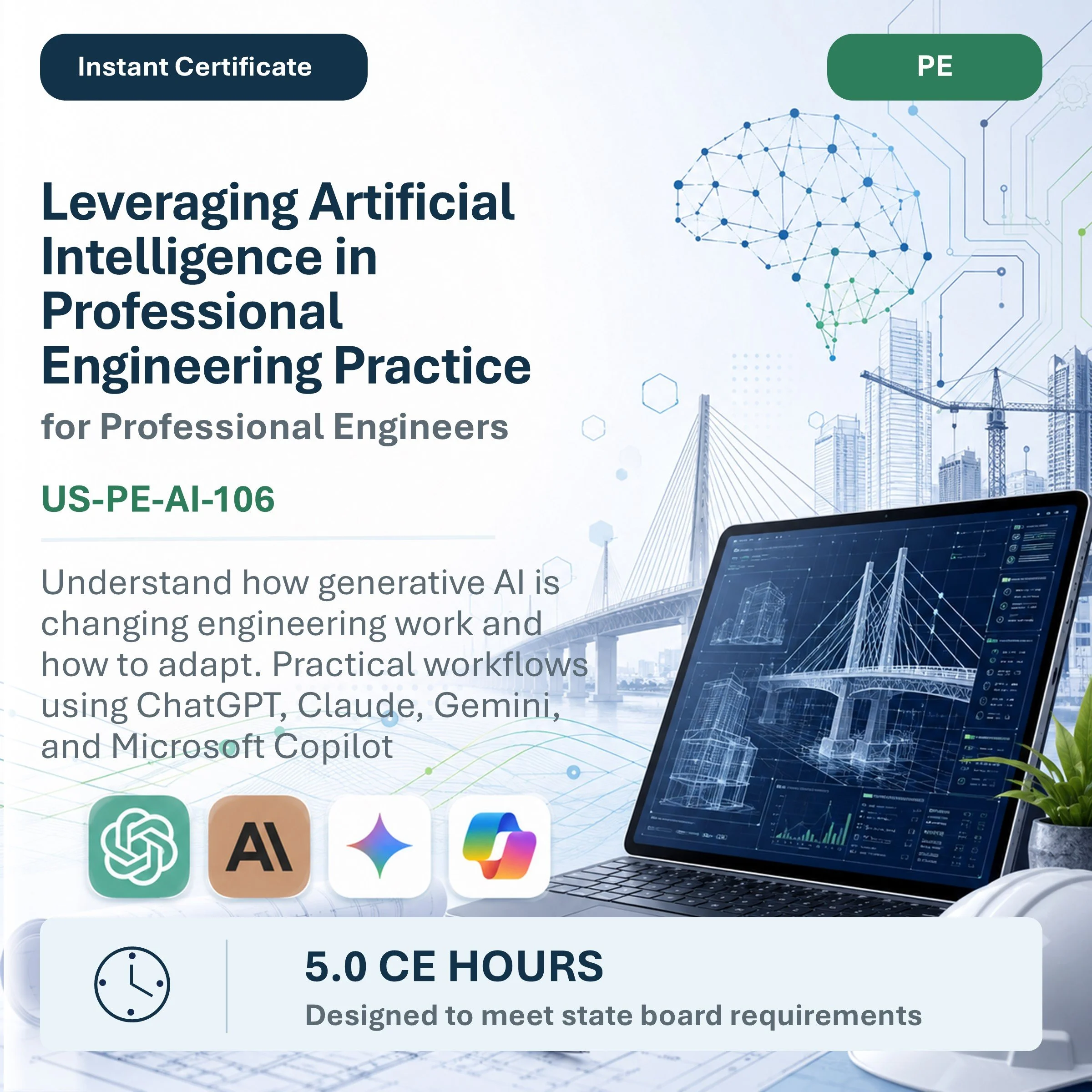
Leveraging AI in Engineering Practice
5 PDH
AI Masterclass
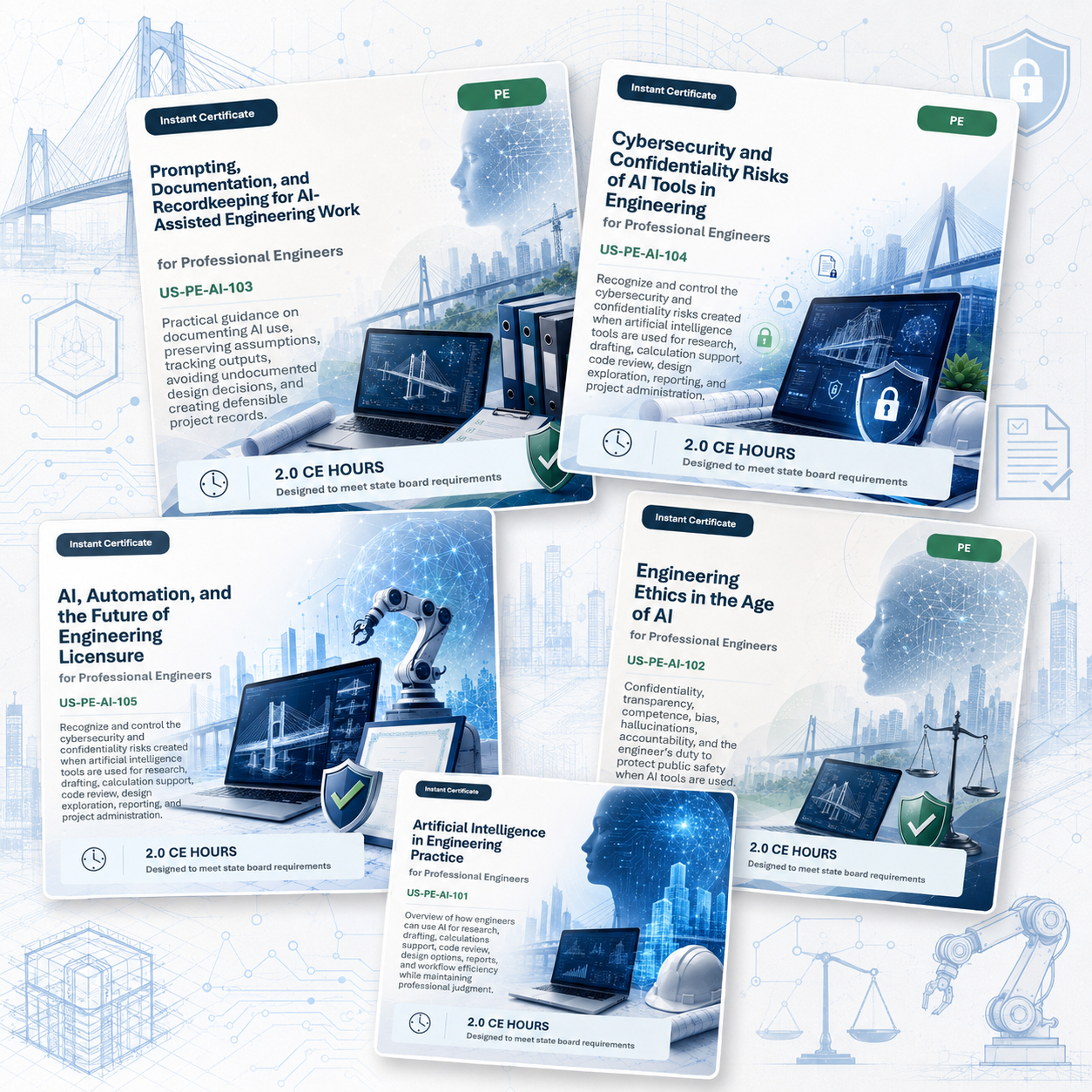
15-Hour AI for PE Bundle
15 PDH
Stay on top of AI For Engineering
Qualifying Activities
South Carolina regulations recognize the following methods of earning PDH:
Successful completion of college courses.
Successful completion of continuing education courses.
Short courses, tutorials, webinars, and distance-education courses.
Face-to-face or live internet-based programs.
Archived prerecorded or archived correspondence programs.
Teaching or instructing qualifying courses or programs.
Authoring published technical or professional papers, articles, or books.
Active participation in professional or technical societies.
Successful application for patents.
One hour of attendance in qualifying coursework, seminars, or professional or technical presentations generally equals one PDH. One continuing education unit equals 10 PDH. Teaching credit is doubled but is available only for the first presentation of a course or seminar and does not apply to full-time faculty.
Active participation in a professional or technical society is limited to two PDH per organization and four PDH per year. The licensee must serve as an officer, actively participate on a committee, or document attendance at least 50% of the meetings of an organization that meets at least eight times per year.
Online Courses, Webinars, and Distance Education
Online, webinar, and archived distance-education activities may qualify when they otherwise satisfy South Carolina requirements. Licensees should retain completion certificates or other documentation supporting participation and credit claimed.
Archived prerecorded programs, live internet-based programs, webinars, and archived correspondence programs are expressly recognized in the regulations, provided they otherwise satisfy the Board’s requirements.
Course and Provider Approval
The South Carolina Board does not preapprove individual courses or continuing-education providers. The licensee is responsible for choosing defensible activities that enhance professional competency and relate to the licensee’s field of practice.
The Board retains final authority regarding whether a course or activity qualifies, the amount of credit allowed, and the method used to earn the credit. Course acceptance may therefore be reviewed during an audit.
SC Artificial Intelligence for PEs and Technical course options
Carryover
A maximum of 15 PDH may be carried forward into the immediately following biennial renewal period. If a licensee claims the full 15-PDH carryover during an audit, the previous renewal period will also be subject to audit verification.
For the 2026 renewal, the Board states that qualifying activities completed after July 1, 2022, that were not used for the 2024 renewal may be accepted as carryover.
Documentation and Record Retention
The licensee is responsible for maintaining records supporting every PDH claimed. Required documentation includes, as applicable:
A log identifying the type of activity.
Sponsoring organization.
Course or activity title and brief description.
Location and date.
Duration.
Instructor or speaker.
Number of PDH earned.
Certificate of completion, attendance verification, or other supporting evidence.
Records maintained through the NCEES Records Program or another recognized repository.
Records must be retained for at least two renewal cycles, during which the Board may request copies for audit verification. Because South Carolina renewals are biennial, this generally represents approximately four years.
Meet Your General Technical PE Hour Requirements
Frequently Asked Questions
-
A South Carolina professional engineer generally must complete 30 PDH during each biennial renewal period. For the 2026 renewal, the reporting period is July 1, 2024 through June 30, 2026.
-
The deadline to renew a 2026–2028 individual professional engineer license without a late penalty is July 31, 2026. Late penalties apply during August and September 2026, and after September 30, 2026, practice is no longer allowed until the license is reinstated.
-
Yes. Online courses may qualify. When provider-documented attendance is unavailable, the course must require an exam for completion and the provider must issue a completion certificate. When attendance is documented and a certificate of attendance is issued, an exam is not required.
-
No. The Board does not preapprove courses or sponsoring organizations. The licensee must select activities with a clear purpose and objective that maintain, improve, or expand skills and knowledge relevant to the licensee’s field of practice, subject to Board review.
Course Syllabus
-
Combines six courses covering AI fundamentals, engineering ethics, prompting and documentation, cybersecurity and confidentiality, automation and licensure, and practical AI implementation. Learners examine engineering applications, hallucinations, verification, responsible charge, data protection, recordkeeping, tool selection, workflow design, professional accountability, and the use of platforms such as ChatGPT, Claude, Gemini, and Microsoft Copilot. Includes applied scenarios, exercises, companion videos, and a final assessment for each course.
Bundle includes the following courses:
US-PE-AI-101 Artificial Intelligence in Engineering Practice
US-PE-AI-102 Engineering Ethics in the Age of AI
US-PE-AI-103 Prompting, Documentation, and Recordkeeping for AI-Assisted Engineering Work
US-PE-AI-104 Cybersecurity and Confidentiality Risks of AI Tools in Engineering
US-PE-AI-105 AI, Automation, and the Future of Engineering Licensure
US-PE-AI-106 Leveraging Artificial Intelligence in Professional Engineering Practice
-
This course helps professional engineers understand how generative AI is changing engineering work and how they can adapt without surrendering professional judgment, technical accountability, or responsibility for public safety. Learners review practical workflows using ChatGPT, Claude, Gemini, and Microsoft Copilot for research, document analysis, technical communication, calculation support, project administration, quality control, and professional development.
The course is designed as a practical guide for evaluating, selecting, and applying AI tools in professional engineering workflows. It emphasizes appropriate use cases, productivity gains, effective prompting, verification of AI-assisted outputs, confidentiality protection, and continued professional accountability.
Will AI Replace Engineers? Understanding the Real Career Risk
Examine the realistic career implications of AI for professional engineers. It distinguishes between tasks, roles, and professions, emphasizing that AI is more likely to change routine production tasks than eliminate professional accountability. Learners assess where AI can accelerate work and where human judgment, field awareness, stakeholder communication, and responsible decision-making remain essential.
Choosing the Right AI Tool for the Engineering Task
Review tool selection as an engineering decision. Learners compare platforms such as ChatGPT, Claude, Gemini, and Microsoft Copilot based on task fit, source grounding, confidentiality controls, workflow integration, traceability, and cost. The module emphasizes matching the tool to the task, data classification, source requirements, and organizational controls rather than selecting a platform by brand preference.
Prompting and Workflow Design for Professional Engineers
Treat prompting as a form of lightweight technical specification writing. Learners review how to define objectives, context, constraints, sources, output format, uncertainty, and verification requirements. The module emphasizes source-bounded prompting, staged workflows, verification architecture, context management, revision control, and reusable prompt design for engineering tasks.
High-Value AI Applications Across Engineering Disciplines
Identify practical AI use cases across engineering disciplines, including research and requirements analysis, drafting and technical communication, calculation support, code review, technical automation, design-option development, trade studies, reports, specifications, quality control, and project administration. The module emphasizes that AI may improve speed and organization, but engineering conclusions still require discipline-specific competence, verification, and accountability.
Using AI Without Jeopardizing Your License, Employer, or Client
Focus on professional risk management when using AI. Topics include competence, responsible charge, confidentiality, privacy, security, intellectual property, source integrity, documentation, defensibility, organizational governance, incident response, correction, and adoption planning. The module reinforces that AI does not hold a license, owe a duty to the public, or accept disciplinary consequences; professional duties remain with the engineer.
Ten Key Points and Practical AI Use Checklist
The course closes with a practical review emphasizing that AI changes workflows but not professional accountability. Key points include choosing tools based on task and controls, using prompts as technical specifications, verifying AI-generated technical output, protecting confidential information, documenting material AI use, and retaining responsibility for competence, public protection, responsible charge, truthful communication, and final approval.
-
This course introduces professional engineers to practical, responsible uses of artificial intelligence in engineering work. Topics include AI-assisted research, drafting, calculations, code review, design-option development, reports, specifications, workflow efficiency, quality control, confidentiality, and risk management. The course emphasizes verification, independent professional judgment, responsible charge, data protection, and the engineer’s continuing accountability for all final work products.
-
US-PE-ET-101: Engineering Ethics Fundamentals (1 PDH)
US-PE-AI-106: Leveraging AI in Engineering Practice (5 PDH)
15-Hr-AI: 15-Hour Artificial Intelligence Bundle (15 PDH)
US-PE-AI-102: Engineering Ethics in the Age of AI
Training multiple engineers? Ask about group enrollment.