
New York PE Renewal & Continuing Education Requirements
How to renew your New York PE license: Complete the applicable continuing education requirements, confirm your Professional Ethics course is completed, and complete the official online renewal process and payment through New York State Education Department (NYSED). LicensePoint provides continuing education; license renewal is completed through the state.
New York professional engineering licenses are valid for life unless revoked, annulled, suspended, or surrendered, but a professional engineer must maintain a current registration to practice in New York. PE registrations are renewed every three years.
Expiration date. New York does not use one fixed statewide renewal date for all professional engineers. Individual registration periods are adjusted so renewals occur in connection with the licensee's birth month, and the applicable expiration date appears on the licensee's registration. Continuing education must be completed before the expiration of the applicable registration period. Online renewal is generally available during the final five months of the current registration period.
Total continuing education. A New York professional engineer must generally complete 36 hours of acceptable continuing education during each three-year registration period. A registration period shorter than three years is generally prorated at 1 hour for each month of the registration period, up to 36 hours for a PE.
Triennial Continuing Educations & Ethics Requirement
At least 1 hour of professional ethics is required during each triennial registration period. Acceptable ethics education must increase the engineer's knowledge of ethical standards applicable to professional practice. New York identifies subjects such as professional laws and regulations, ethical issues within an engineering discipline, ethical dilemmas, public expectations, professional responsibilities, judgment, values, and related professional-practice issues as potentially appropriate ethics content.
New York does not impose a separate general HSW-hour requirement on professional engineers comparable to some other jurisdictions. Instead, acceptable subject matter must contribute to professional engineering practice and the development or maintenance of professional knowledge. Engineering disciplines and matters of law or ethics that contribute to professional practice and the health, safety, or welfare of the public are among the expressly identified acceptable subject areas.
Complete online, self-paced courses engineered specifically to satisfy New York criteria, including the mandatory Ethics requirement. Certificate automatically issued upon completion
Complete Your Continuing Education Hours Online
Ethics and Artificial Intelligence for PEs Bundle
10 PDH
Complete technical continuing education + Ethics
View syllabus
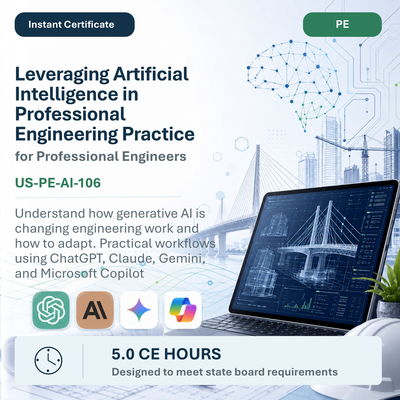
Leveraging AI in Engineering Practice
5 PDH
Technical Area of Practice
View syllabus
Ethics, Artificial Intelligence, & Failure Analysis Bundle
20 PDH
Complete technical continuing education + Ethics
View syllabus
Fundamentals of Engineering Ethics
1 PDH
Mandatory Ethics Requirement
View syllabus
Try Our Audio Podcast Format for PE Ethics

Fulfill your mandatory New York Ethics Course.
US-PE-ET-103 - Audio Podcast Ethics for Professional Engineers
Listen from the course web page or your favorite podcast platform.
Designed specifically for busy engineers, these courses delivers your required ethics training in a flexible, audio-first podcast format.
Certificate issued immediately upon completion
Qualifying CPC Activities
Qualifying activities. New York regulations and NYSED guidance recognize qualifying activities including:
University and college courses and professional-development or technical-training courses offered through an approved sponsor.
Preparing and teaching qualifying courses, including eligible preparation time.
Authoring qualifying peer-reviewed articles, maps, or other published works.
Technical presentations at qualifying professional conferences or meetings.
Obtaining a patent related to professional engineering practice.
Structured on-demand educational activities using audio, audiovisual, written, online, or other media.
Structured educational tours of an instructional nature.
Professional service on qualifying committees or task forces addressing technical or regulatory professional-practice issues; credit is generally 1 hour for every 2 hours of qualifying service, with a maximum of 9 hours per registration period for that activity.
Online, self-study, and webinar rules. New York permits structured on-demand education delivered through online, written, audio, audiovisual, or similar media when it is provided by an approved sponsor, covers an acceptable subject area, and meets the required format. An on-demand educational activity must include a testing or participation-verification mechanism for credit. NYSED gives examples such as questions during the course, a final quiz, periodically entered course codes, attendance prompts, and an end-of-course attestation. Independent self-study or informal study groups that are not conducted through an approved sponsor are not accepted.
Provider and course approval. New York is an approved-sponsor jurisdiction. To qualify, a course or educational activity generally must be administered by an approved New York sponsor/provider, address an acceptable subject area, and use an acceptable format. Under 8 NYCRR §68.14(i)(2)(iii), New York deems approved a continuing-education sponsor that is approved by another jurisdiction’s licensing authority or agency under standards substantially equivalent to those of the Department.
New York Ethics, AI, and Technical course options
Carry-Forward & Recordkeeping Rules
A maximum of 6 continuing education hours completed during one triennial registration period may be transferred to the subsequent triennial registration period. Because the regulation separately requires at least one ethics hour during each triennial period, I would not market prior-period ethics as satisfying the next period's ethics requirement without specific NYSED confirmation.
Documentation and record retention. Each licensee must maintain records identifying the learning activity, course title where applicable, subject, number of hours, sponsor and identifying number if applicable, verification of attendance or participation, and the date and location of the activity. These records must be retained for at least 6 years from the date the continuing education was completed. Sponsors are expected to provide certificates of completion; self-reporting forms are not accepted as proof of New York CE credit.
Renewal & Exemptions
A PE generally does not submit all CE certificates with the routine registration renewal. Instead, the licensee certifies that the continuing education requirement has been completed and retains the underlying documentation. NYSED conducts audits of continuing-education records and may require the licensee to submit completion documentation. Discrepancies, including willfully false reporting, may lead to professional-misconduct proceedings and disciplinary consequences.
Exemptions and special rules. A PE who is initially licensed in New York through the normal New York licensure process is generally exempt from CE during the initial three-year registration period. That initial-period exemption does not apply in the same manner to a person first licensed in New York through endorsement of another jurisdiction's license; NYSED states that such a licensee must complete 1 hour per month of the registration period.
New York also has a narrowly defined public-sector exemption for certain professional engineers who were directly employed full-time in qualifying New York State or local-government positions on December 31, 2003, met specified employment-status conditions, and have remained within the statutory conditions. Licensees who are not registered and not practicing in New York are generally exempt while inactive, but additional CE requirements apply when returning to practice. Adjustments may also be granted for documented health conditions, disability, extended active military duty, or other good cause accepted by the Department.
Meet Your General Technical PE Hour Requirements
Frequently Asked Questions
-
A New York professional engineer generally must complete 36 hours of acceptable continuing education during each three-year registration period. At least 1 hour must be in professional ethics. Shorter registration periods are generally prorated at 1 hour per month.
-
Yes. Beginning January 1, 2022, up to 6 continuing education hours completed during one triennial registration period may be transferred to the subsequent triennial registration period.
-
New York allows structured on-demand educational activities, including audio, audiovisual, written, and online formats, when they are provided by an approved sponsor, cover an acceptable subject area, use an approved format, and include a testing or participation-verification instrument. Independent self-study that is not through an approved sponsor is not accepted.
-
Licensees must retain continuing education records for at least 6 years from the date of completion. At renewal they certify compliance rather than routinely submitting records, but the Department may audit and require supporting documentation.
Course Syllabus
-
US-PE-ET-101 Engineering Ethics Fundamentals for Professional Engineers
Covers public protection, competence, responsible charge, truthful communication, and conflicts of interest. Includes four practical video scenarios: The Compressed Review, The Familiar Client, Unfamiliar Scope, The Completed Drawing Set, and The Report Before Closing. Followed by a final quiz.
-
Designed specifically for busy engineers, this course delivers your required ethics training in a flexible, audio-first podcast format. Ideal for listening during your daily commute, a walk, or while traveling, this course breaks down the core ethical obligations every Professional Engineer owes to the public, clients, employers, and the engineering profession. Through realistic, cross-disciplinary scenarios, you will examine real-world trade-offs between public safety, project constraints, and professional duty.
What You'll Learn
Core obligations under the PE Code of Ethics across multiple disciplines.
How to navigate competing duties to public safety, clients, and employers.
Practical strategies for identifying and managing ethical risk on active projects.
-
Combines six courses covering AI fundamentals, engineering ethics, prompting and documentation, cybersecurity and confidentiality, automation and licensure, and practical AI implementation. Learners examine engineering applications, hallucinations, verification, responsible charge, data protection, recordkeeping, tool selection, workflow design, professional accountability, and the use of platforms such as ChatGPT, Claude, Gemini, and Microsoft Copilot. Includes applied scenarios, exercises, companion videos, and a final assessment for each course.
Bundle includes the following courses:
US-PE-AI-101 Artificial Intelligence in Engineering Practice
US-PE-AI-102 Engineering Ethics in the Age of AI
US-PE-AI-103 Prompting, Documentation, and Recordkeeping for AI-Assisted Engineering Work
US-PE-AI-104 Cybersecurity and Confidentiality Risks of AI Tools in Engineering
US-PE-AI-105 AI, Automation, and the Future of Engineering Licensure
US-PE-AI-106 Leveraging Artificial Intelligence in Professional Engineering Practice
US-PE-FA-101 Failure Analysis and Lessons Learned
-
This course helps professional engineers understand how generative AI is changing engineering work and how they can adapt without surrendering professional judgment, technical accountability, or responsibility for public safety. Learners review practical workflows using ChatGPT, Claude, Gemini, and Microsoft Copilot for research, document analysis, technical communication, calculation support, project administration, quality control, and professional development.
The course is designed as a practical guide for evaluating, selecting, and applying AI tools in professional engineering workflows. It emphasizes appropriate use cases, productivity gains, effective prompting, verification of AI-assisted outputs, confidentiality protection, and continued professional accountability.
Will AI Replace Engineers? Understanding the Real Career Risk
Examine the realistic career implications of AI for professional engineers. It distinguishes between tasks, roles, and professions, emphasizing that AI is more likely to change routine production tasks than eliminate professional accountability. Learners assess where AI can accelerate work and where human judgment, field awareness, stakeholder communication, and responsible decision-making remain essential.
Choosing the Right AI Tool for the Engineering Task
Review tool selection as an engineering decision. Learners compare platforms such as ChatGPT, Claude, Gemini, and Microsoft Copilot based on task fit, source grounding, confidentiality controls, workflow integration, traceability, and cost. The module emphasizes matching the tool to the task, data classification, source requirements, and organizational controls rather than selecting a platform by brand preference.
Prompting and Workflow Design for Professional Engineers
Treat prompting as a form of lightweight technical specification writing. Learners review how to define objectives, context, constraints, sources, output format, uncertainty, and verification requirements. The module emphasizes source-bounded prompting, staged workflows, verification architecture, context management, revision control, and reusable prompt design for engineering tasks.
High-Value AI Applications Across Engineering Disciplines
Identify practical AI use cases across engineering disciplines, including research and requirements analysis, drafting and technical communication, calculation support, code review, technical automation, design-option development, trade studies, reports, specifications, quality control, and project administration. The module emphasizes that AI may improve speed and organization, but engineering conclusions still require discipline-specific competence, verification, and accountability.
Using AI Without Jeopardizing Your License, Employer, or Client
Focus on professional risk management when using AI. Topics include competence, responsible charge, confidentiality, privacy, security, intellectual property, source integrity, documentation, defensibility, organizational governance, incident response, correction, and adoption planning. The module reinforces that AI does not hold a license, owe a duty to the public, or accept disciplinary consequences; professional duties remain with the engineer.
Ten Key Points and Practical AI Use Checklist
The course closes with a practical review emphasizing that AI changes workflows but not professional accountability. Key points include choosing tools based on task and controls, using prompts as technical specifications, verifying AI-generated technical output, protecting confidential information, documenting material AI use, and retaining responsibility for competence, public protection, responsible charge, truthful communication, and final approval.
-
This five-course bundle provides professional engineers with a practical introduction to the use of artificial intelligence in engineering practice and the professional responsibilities associated with AI-assisted work. The curriculum begins with US-PE-AI-101 — Artificial Intelligence in Engineering Practice, addressing appropriate AI applications, limitations, source verification, assumptions, calculations, and output review. US-PE-AI-102 — Engineering Ethics in the Age of AI examines ethical decision-making, professional judgment, confidentiality, verification, and the engineer’s continuing responsibility for defensible work products. US-PE-AI-103 — Prompting, Documentation, and Recordkeeping for AI-Assisted Engineering Work focuses on effective prompting and documentation of AI inputs, outputs, decisions, review steps, and quality-control processes.
The bundle continues with US-PE-AI-104 — Cybersecurity and Confidentiality Risks of AI Tools in Engineering, which addresses data classification, protection of client and project information, cybersecurity risks, and appropriate controls when using AI platforms. US-PE-AI-105 — AI, Automation, and the Future of Engineering Licensure examines how emerging technologies may affect engineering competence, responsible charge, professional judgment, and the evolving role of licensed engineers. Together, the five courses emphasize AI as a support tool rather than a substitute for engineering competence, verification, accountability, or final professional review.
Training multiple engineers? Ask about group enrollment.