
How to renew your Florida PE license: Complete the applicable continuing education requirements, report your CE, confirm your Laws & Rules completion is recorded, and complete the official online renewal process and payment through DBPR. LicensePoint provides continuing education; license renewal is completed through the state.
Florida PE Renewal & Continuing Education Requirements
Florida professional engineers are regulated by the Florida Board of Professional Engineers (FBPE) under Chapter 471, Florida Statutes, and Chapter 61G15, Florida Administrative Code. Florida uses a biennial renewal cycle. Active PE licenses generally expire on February 28 of each odd-numbered year. The current continuing-education period runs from March 1, 2025, through February 28, 2027.
Total Continuing Education Requirement
A Florida PE must complete 18 continuing education hours during each two-year renewal period. Florida law describes this as 9 hours for each year of the renewal period, totaling 18 hours for the biennium.
The 18 hours must include:
1 hour concerning Chapter 471, Florida Statutes, and the Board’s rules
1 hour of professional ethics
4 hours related to the licensee’s area of practice
12 additional hours addressing any topic pertinent to the practice of engineering
The Florida laws-and-rules hour must be obtained from a Florida Board-approved provider and approved course. The ethics course does not have to be Florida-specific; the required ethics hour must be obtained from a professional ethics course approved for credit in a U.S. jurisdiction.
Complete Your Florida PE Continuing Education Online
Get fully compliant with our 100% online, self-paced courses engineered specifically to satisfy Florida criteria, including the mandatory Florida Laws & Rules Course and the Professional Ethics requirements. Certificate automatically issued upon completion
Florida Board of Professional Engineers Continuing Education Provider number: 0010824
Engineering Ethics Fundamentals
1 PDH
Mandatory Florida Ethics Requirement
Florida Laws and Rules Course
1 PDH
Mandatory Requirement
Florida Required Topics Bundle
2 PDH
Complete Required Florida Laws + Ethics
Florida Laws & Rules (1 Hour) + Engineering Ethics (1 Hour) + Artificial Intelligence for PEs (7 Hours)
9 PDH
State Certificate Compliance: Course certificates follow Rule 61G15-22.012(1)(c), F.A.C., containing PE license numbers, dates, and course topic descriptions.
Approved Florida Continuing Education Provider Number 0010824, License Number 909
We report your 1-Hour Laws & Rules credit directly to Florida DBPR
Qualifying Activities
Florida statutes expressly allow continuing-education credit for activities such as:
Presenting or attending engineering seminars
In-house or nonclassroom courses
Engineering workshops
Professional or technical presentations at meetings
Webinars
Conventions and conferences
Vendor presentations when the vendor has specific knowledge relevant to the licensee’s area of practice
Serving as an officer of, or actively participating on a committee of, a Board-recognized professional or technical engineering society
A licensee may earn up to 4 hours through qualifying service as an officer or active committee participant in a Board-recognized engineering society. Service as a member of the Florida Legislature or as an elected state or local official may satisfy the required Florida laws-and-rules and ethics hours.
Courses and activities should improve, advance, or extend the engineer’s professional knowledge and must be pertinent to engineering practice. A PE should retain sufficient documentation to demonstrate the activity’s subject matter, date, provider or sponsor, and hours awarded.
Online Courses, Self-Study, and Webinars
Florida expressly permits nonclassroom courses and webinars. The statute does not impose a general classroom-attendance requirement for all CE hours. The licensee remains responsible for determining whether an activity is pertinent to engineering practice and for maintaining documentation sufficient to support the claimed credit.
For online courses, a completion certificate or comparable documentation should identify the participant, course, provider, completion date, and number of hours awarded.
Provider and Course Approval
Florida Board approval is specifically required for the 1-hour Florida laws-and-rules course. Board-approved providers offering that course must report licensee completions through Florida’s provider reporting system.
Other technical and ethics continuing-education providers generally do not directly report course completions to FBPE. Those providers must furnish appropriate completion documentation, and the engineer remains responsible for reporting and substantiating the credit.
Board approval of a provider should not be interpreted as automatic approval of every course offered by that provider. Florida laws-and-rules courses are separately subject to the Board’s course-approval requirements.
Try Our Audio Podcast Format for PE Ethics

Fulfill your mandatory Florida Ethics Course.
US-PE-ET-103 - Audio Podcast Ethics for Professional Engineers
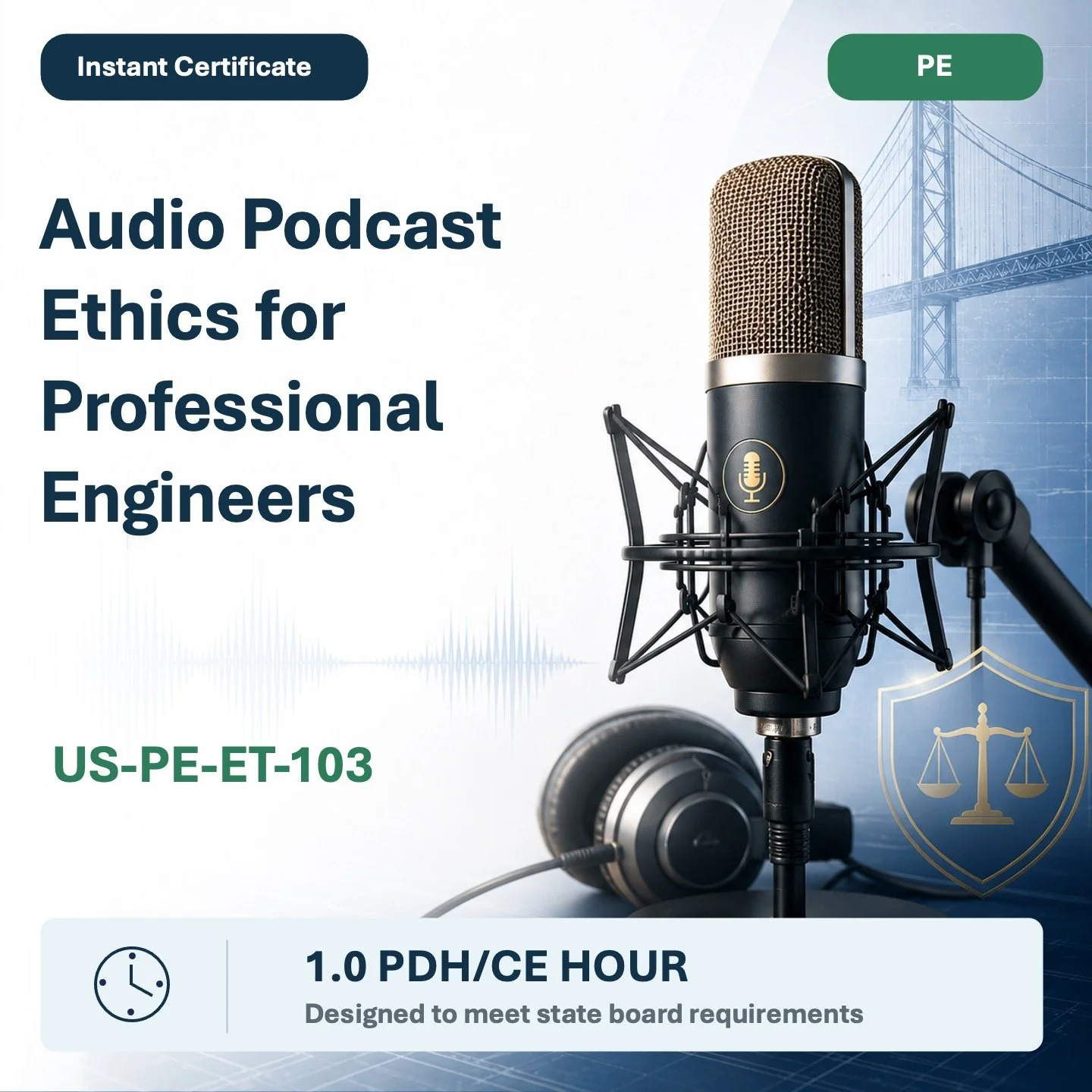
Stream the podcast-style audio modules on your phone or computer at your own pace from the course web site or your favorite podcast platform. Then take the mobile-friendly quiz and receive your certificate of completion.
Designed specifically for busy engineers, this course delivers your required ethics training in a flexible, audio-first podcast format.
Florida Laws & Rules, Ethics, Technical course options
Approved Florida Continuing Education Provider Number 0010824
Reporting Continuing Education
Florida PEs must report completed CE using the NCEES CPC Tracking system. For the current cycle, the reporting period is March 1, 2025, through February 28, 2027.
The engineer should upload documentation as courses are completed but should transmit the CE transcript to FBPE only after completing and documenting all 18 required hours. CE certificates cannot be submitted to the Board by ordinary email or fax as a substitute for the required reporting process.
Florida laws-and-rules completions are also reported directly by the approved course provider. Licensees should verify through their Florida licensing account that the laws-and-rules completion has been recorded.
Documentation and Record Retention
Florida PEs must retain certificates, receipts, vouchers, or other records necessary to demonstrate CE compliance for 4 years from the date of completion of each activity.
Useful documentation may include:
Course completion certificates
Receipts or registration records
Attendance verification
Letters from colleges or universities documenting qualifying teaching
Copies of peer-reviewed technical papers and evidence of peer review
Records of qualifying professional-society service
Documentation of elected public service when used for laws-and-rules or ethics credit
A standard course certificate should identify the course title, provider, credit awarded, and completion date. Current Florida provider rules also require additional identifying information on certificates, including the participant’s Florida PE number.
Carry-Forward & Recordkeeping Rules
Florida does not permit unused or excess continuing-education hours to carry forward. All claimed hours must be earned during the specific biennium for which they are reported.
Meet Your General Technical PE Hour Requirements
Frequently Asked Questions
-
Florida PEs must complete 18 continuing education hours during each biennial renewal period. The current CE period is March 1, 2025, through February 28, 2027.
-
The 18 hours must include 1 hour of Florida laws and rules from a Board-approved provider, 1 hour of professional ethics, and 4 hours related to the licensee’s area of practice. The remaining 12 hours may address any topic pertinent to engineering practice.
-
Yes. Florida PEs must report completed CE through the NCEES CPC Tracking system. Florida laws-and-rules course completions are also reported directly by the Board-approved provider, and licensees should verify that completion appears in their Florida licensing account.
-
No. Florida CE credits must be earned within the biennium for which they are claimed. Licensees must retain certificates, receipts, vouchers, or other supporting records for 4 years from the date of the activity.
Course Syllabus
-
Provides Florida professional engineers with a practical review of the statutes and administrative rules governing engineering licensure and practice in the state. The course addresses the authority and responsibilities of the Florida Board of Professional Engineers, the legal definition and scope of engineering practice, licensure and renewal obligations, responsible charge, use of the professional engineer seal, firm authorization requirements, disciplinary grounds, and the professional duties associated with protecting the public.
Through concise instruction and applied scenarios, learners examine how Florida requirements affect common engineering decisions, including signing and sealing documents, supervising delegated work, communicating with clients and public agencies, maintaining professional records, and responding to potential violations. The course emphasizes accurate interpretation of Chapter 471, Florida Statutes, and applicable provisions of Chapter 61G15, Florida Administrative Code, while reinforcing the engineer’s continuing responsibility to exercise competent judgment and verify current requirements before acting.
-
Covers public protection, competence, responsible charge, truthful communication, and conflicts of interest. Includes four practical optional video scenarios: The Compressed Review, The Familiar Client, Unfamiliar Scope, The Completed Drawing Set, and The Report Before Closing. Followed by a final quiz.
-
Designed specifically for busy engineers, this course delivers your required ethics training in a flexible, audio-first podcast format. Ideal for listening during your daily commute, a walk, or while traveling, this course breaks down the core ethical obligations every Professional Engineer owes to the public, clients, employers, and the engineering profession. Through realistic, cross-disciplinary scenarios, you will examine real-world trade-offs between public safety, project constraints, and professional duty.
What You'll Learn
Core obligations under the PE Code of Ethics across multiple disciplines.
How to navigate competing duties to public safety, clients, and employers.
Practical strategies for identifying and managing ethical risk on active projects.
-
This course examines how AI and automation may affect engineering practice, licensure expectations, responsible charge, professional competence, supervision, documentation, and board-risk issues. Learners review the difference between task automation and professional responsibility, the limits of automated outputs, the continuing role of engineering judgment, and the importance of verification and accountability as technology changes.
The course is intended to help professional engineers adapt to AI-enabled practice while preserving the core licensure duties of competence, public protection, truthful communication, and responsible professional review. -
Covers AI career impact, tool selection, prompting, workflow design, engineering applications, verification, confidentiality, documentation, governance, and professional accountability. Includes practical exercises using ChatGPT, Claude, Gemini, and Microsoft Copilot, along with applied workshops, optional companion videos, and a final quiz.
Training multiple engineers? Ask about group enrollment.